
Local guide
Exterior cleaning in Bayside: the complete guide
Bayside is a retail stage, and the floor is always on
Most exterior cleaning jobs in Miami happen on a private lot where nobody's watching. Bayside is the opposite. This is open-air retail on Biscayne Bay — two levels of storefronts, a food court that opens onto the promenade, live-music decks, tour-boat gangways, and a marina edge where thousands of visitors stop, lean on the railing, and take a photo every single day. The exterior is not a maintenance afterthought here. It is the selling floor. A grease shadow spreading out from a food stall, a black gum constellation on the pavers, or a hazed-over vestibule glass door reads instantly as "tired," and on a waterfront where the competition is the view itself, tired costs money.
That changes how the cleaning has to be done. It's not just about getting a surface clean — it's about getting it clean without shutting the property down, without leaving wand stripes down a high-visibility walkway, and without a slippery, over-wet mess during business hours. Bayside rewards a crew that understands the operation, not just the equipment.
Why the salt problem here is worse than a few blocks inland
Bayside doesn't sit near the water. It sits on it. The promenade, the marina slips, and the bay-facing storefronts are exposed to salt-laden air that comes off Biscayne Bay all day, with nothing to break it. That puts the property squarely in the aggressive end of the coastal corrosion spectrum — the ISO 9223 C5-M "marine" category, the same classification used for structures in direct salt spray.
What that means in practice:
- Glass hazes fast. Airborne salt bonds to the surface of storefront and vestibule glass and builds a cloudy film that a squeegee alone won't shift. Bay-facing panes genuinely need a tighter cycle than inland glass to stay clear rather than dull.
- Metal corrodes early. The railings everyone leans on, awning frames, door hardware, light fixtures, and marina rail all pit and rust faster here than on a comparable building even in Brickell. Cleaning them gently and regularly — never blasting off the coating with high pressure — is the difference between slowing that corrosion and accelerating it.
- Calcium sits on top of the salt. Miami has the hardest tap water among the state's major cities, roughly 11 grains per gallon out of the Biscayne Aquifer. Rinse water and irrigation overspray leave calcium spotting on glass and metal that plain water won't remove, so it has to be treated, not just wiped.
None of that is fixed by turning the pressure up. It's fixed by matching the method to the surface — soft washing and the right chemistry on glass, painted metal, awnings, and stucco; calibrated flat-surface cleaning only where the concrete or pavers can take it.
The slip-and-fall angle nobody markets, but every property manager should care about
Humidity plus shade plus foot-traffic residue grows biofilm — that thin gray-green film on concrete near the water and on the marina decking. It's not just ugly. When it gets wet, and near the bay it's wet most mornings, it's genuinely slippery. On a property that moves tourist crowds all day, a slick walkway or a green boardwalk plank is a liability exposure, not a cosmetic one. Scheduled soft washing that kills the growth at the root keeps those surfaces both presentable and safe, which is a much easier line item to justify than "the pavers looked dingy."
Gum, grease, and grime: the food-court reality
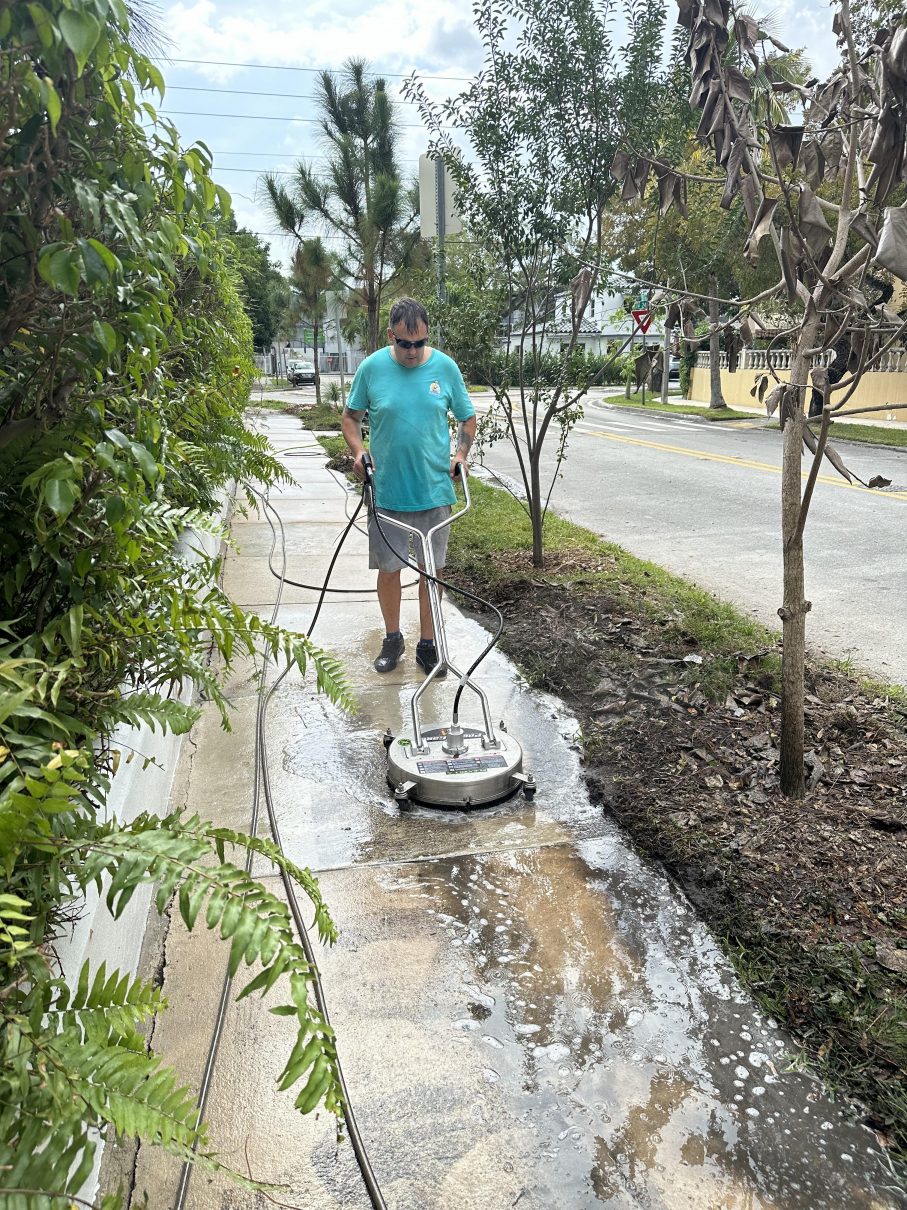
An open-air food court on a promenade produces a specific kind of mess. Grease vaporizes off the stalls and settles into a shadow on the surrounding pavers. Spilled drinks and dropped food ferment into stains. And gum — endless gum — gets ground black into the texture of the concrete where a garden hose and a mop will never reach it. Hot-water surface cleaning is what actually lifts this: the heat breaks down the grease and softens the gum so a flat surface cleaner can pull it off evenly, without gouging the concrete or striping the walkway. Cold water and raw pressure just push it around and leave marks.
A realistic cleaning cadence for a working waterfront
Because Bayside stacks salt, humidity, and heavy use, a "once a year and forget it" approach doesn't hold here. A rough cadence that fits the property:
- Bay-facing glass — every 6 to 8 weeks. Salt and calcium set in fast on the water side.
- Promenade and food-court walkways — recurring, tuned to traffic. High-traffic food-court runs may want monthly or bimonthly attention; quieter stretches, quarterly.
- Railings, awning frames, and hardware — regular gentle cleaning is the best defense against C5-M corrosion; the exact interval depends on how exposed the run is.
- Marina and boardwalk decking — soft washed on a schedule before the green film turns into a slip problem.
- Stucco and painted facades — soft washed as mold and mildew reappear, which in Miami's humidity is more often than most owners expect.
Recurring maintenance plans exist precisely so nobody has to track all of that — we set the intervals per surface and just show up.
Timing it around events and the storm calendar
Two calendars matter at Bayside. The first is the property's own event schedule — festivals, boat shows, holiday crowds. Exterior cleaning is best done in the quiet window ahead of those, early morning before doors effectively open, so a high-visibility walkway is dry and spotless when the crowd arrives, not roped off and wet.
The second is hurricane season, June 1 through November 30. The smart pre-season window is April and May. Clean roofs and clear drains shed water; on a low, bay-level property, clogged gutters and drains — palm fronds and seagrape leaves are the usual culprits — overflow toward the building instead of away from it. Getting exteriors cleaned and drains cleared before the first storm bands arrive is cheap insurance compared to what standing water does.
What "no shortcuts" actually looks like here
On a shared, high-traffic waterfront, the details are the job. That means the right method for each surface — soft washing where high pressure would etch stucco, strip a railing coating, or void a roof warranty, and calibrated pressure only where it belongs. It means plant-safe soft-wash chemistry, which matters on a promenade lined with landscaping and steps from the bay. It means before-and-after photos so a property manager can show ownership the work was done, and a 48-hour re-wash guarantee if anything gets missed. And it means full liability and workers-comp coverage, which any reputable shared waterfront property will require on a certificate of insurance before a crew sets foot on site.
Bayside merchants and property managers call Moppey because we treat the marketplace as what it is — a mix of glass, metal, concrete, pavers, decking, and stucco, each wanting a different approach, all sitting in a salt-heavy coastal environment. We clean around your hours, coordinate access, and back the work with 43 real Google reviews. Hablamos español.
If you manage a storefront, a food-court frontage, a marina edge, or a whole building at Bayside, call +1 877-754-5614 for a free quote — send a few photos and we'll recommend the right service and a schedule that fits the property. Most requests are answered the same day. No damage, no streaks, no shortcuts.