In-depth guide
Sidewalk Cleaning in Miami: the complete guide
The complete guide to sidewalk cleaning in Miami
A sidewalk is public-facing in a way almost no other surface on your property is. People form an opinion about a home, a storefront, or a whole HOA the moment their shoe touches the concrete. In Miami, that concrete works against you: heat, humidity, daily sprinkler overspray, and afternoon storms turn a bright walkway gray-green fast, and a neglected path reads as neglect long before anyone reaches the front door. This guide goes past the basics of "we pressure wash it" and into the parts that actually decide the outcome — who owns the sidewalk, what the stains really are, how the finish gets even, and how Miami's climate and rules shape the job.
Who is responsible for the sidewalk — and why it matters
One of the first questions Miami owners ask is whether the strip of concrete out front is even theirs to clean. In most of Miami-Dade, the public sidewalk sits within the city or county right-of-way, but the adjacent property owner is generally expected to keep it clean and safe. That distinction matters for two reasons:
- Liability follows use, not just ownership. A slick, algae-covered public walkway in front of your business or building is a trip-and-fall exposure even if the concrete technically belongs to the city. Keeping it clean is part of protecting yourself, not just protecting the look.
- Commercial and HOA frontage is almost always your job. Storefront sidewalks, plaza walkways, condo breezeways, and community connecting paths are maintained by the property, and boards and managers increasingly treat regular cleaning as routine risk management.
We clean both the private approach — the walkway from the driveway to your door — and the public-facing frontage, and we're happy to talk through where your responsibility begins if you're unsure.
What is actually staining your walkway
"Dirty" is not one thing, and the right method depends on knowing which problem you're looking at. On a typical Miami sidewalk we see a stack of separate issues:
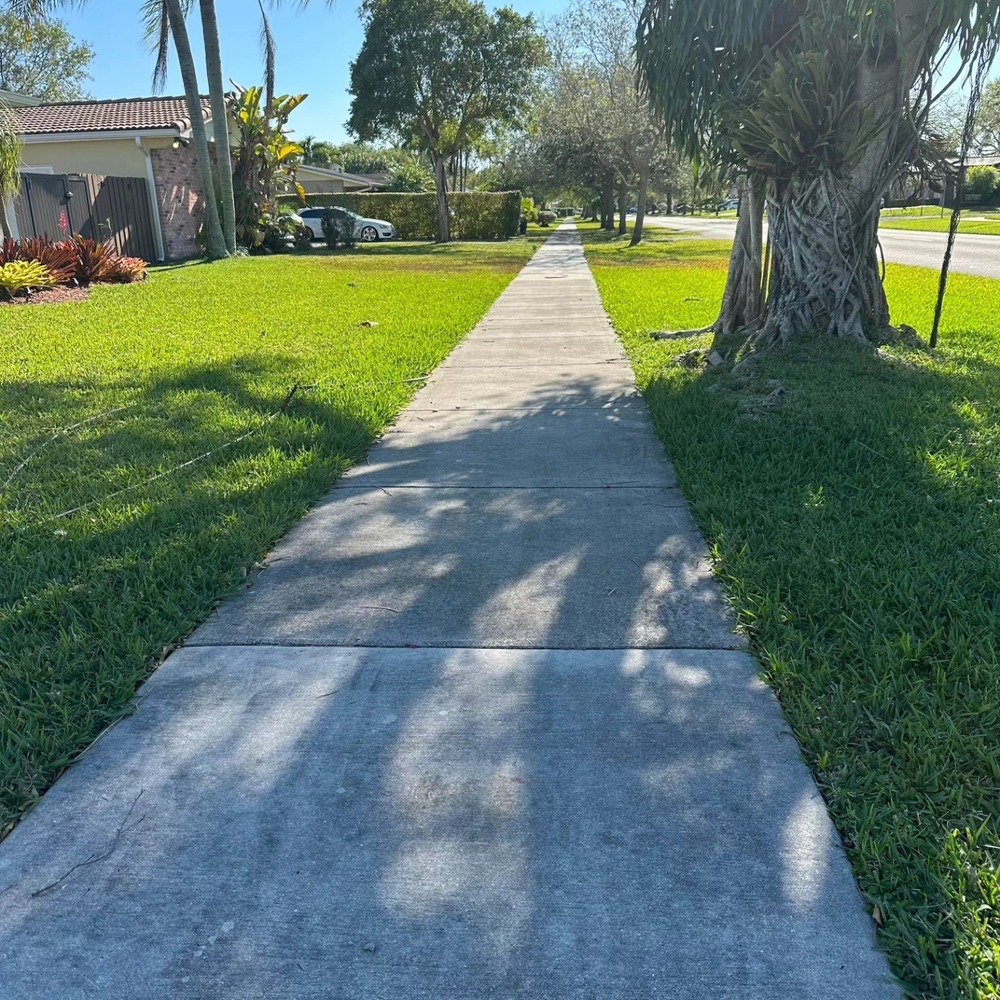
- Algae, mildew, and the green film. The soft green-black growth along shaded and irrigated edges is a living organism feeding on constant moisture. Rinsing knocks the top off; it grows back in weeks unless it's pre-treated and killed at the surface.
- Efflorescence. The chalky white haze that surfaces on newer concrete is efflorescence — mineral salts drawn out of the slab by moisture. It looks like the sidewalk won't come clean, but it's a mineral deposit, not dirt, and it responds to a different treatment than organic growth.
- Irrigation rust and hard-water spotting. Miami sits on the limestone Biscayne Aquifer and has the hardest water among Florida's major cities, around 11 grains per gallon. Sprinklers throwing well or city water across a walkway every morning leave mineral crust and, where there's iron in the line, orange rust fans that a normal wash won't lift.
- Gum, spills, and traffic lanes. Ground-in gum, dropped drinks, grease tracked from a parking lot, and the dark center lane worn by foot traffic each need direct spot work, not just a pass with the machine.
Identifying the mix up front is what separates a clean that lasts from one that looks better for a week. We read the surface before we pick a setting.
Step by step: what a professional sidewalk wash looks like
The finish that reads "cared for" comes from a repeatable sequence, not from blasting harder. On a Moppey job the walkway moves through the same stages every time:
- Walk and assess. We identify the growth, staining, and any cracked, spalling, or lifted sections before water touches the concrete.
- Protect the route. Sidewalks run right past plants, screens, light fixtures, and door thresholds. Landscaping gets pre-wet and shielded so cleaning solution and runoff don't burn it.
- Pre-treat. Algae and mildew get a solution that kills the organism so it releases with the wash instead of getting pushed around. Efflorescence and rust get their own targeted treatment.
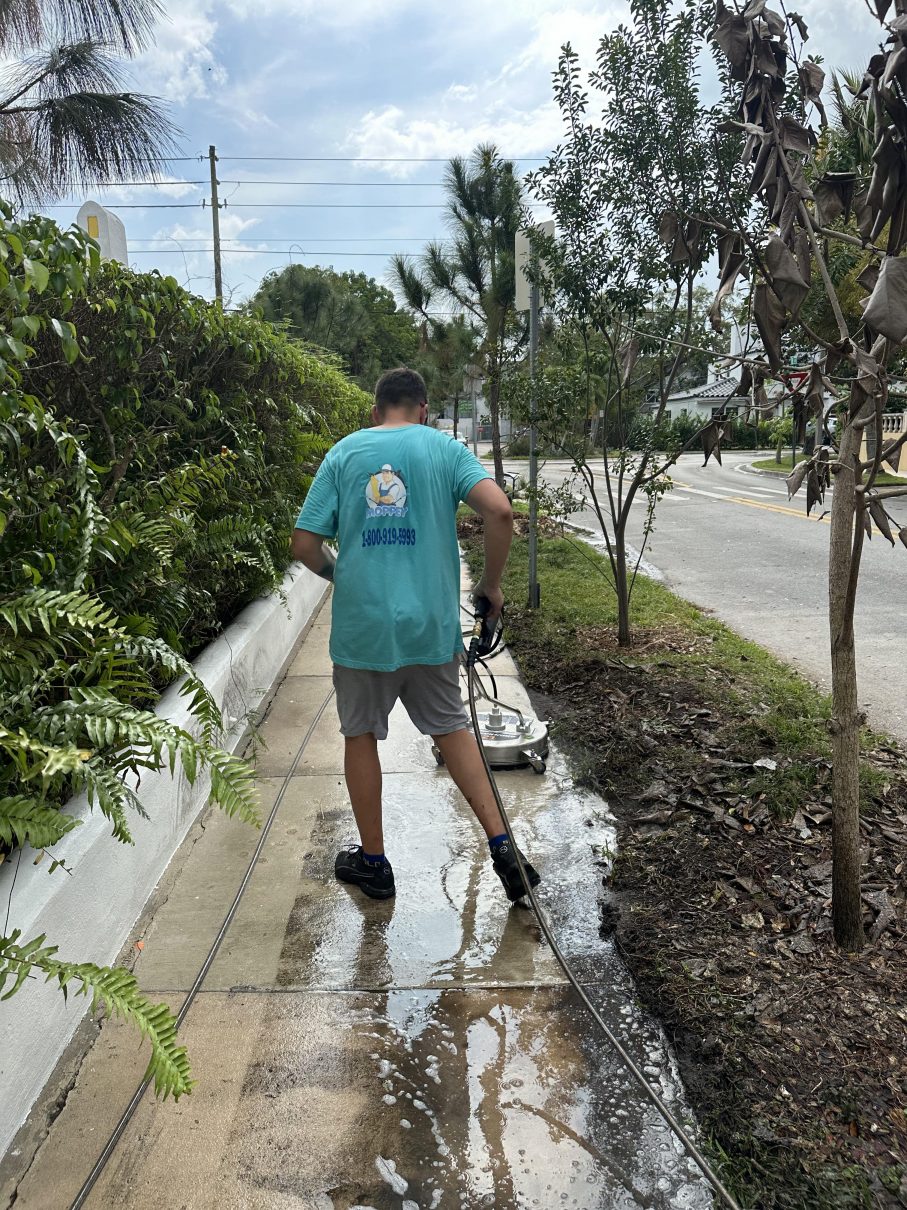
- Surface-clean the full width. A flat, ground-level surface cleaner spins evenly matched jets across the entire path so the whole walkway lifts at the same rate — this is what prevents the light-and-dark "zebra" look from a freehand wand.
- Detail edges, joints, and spots. We hand-clean where concrete meets grass, planters, and walls, and hit gum and stains the machine leaves behind.
- Controlled rinse. We direct the runoff so dirty water doesn't dry back onto your walls, glass, or landscaping.
The surfaces and materials we handle — and how each is treated
Not every "sidewalk" is poured concrete, and the material dictates the pressure and chemistry:
- Poured concrete walkways. Hard and porous. These take honest high-pressure surface cleaning, which is the only thing that cuts ground-in grime out of the pores.
- Brick and concrete pavers. Cleaned with care so joint sand isn't blown out; often better with a controlled pass and re-sanding rather than raw pressure.
- Stamped or colored concrete. Softer sealed surfaces that can be dulled or striped by an aggressive wand — cleaned at lower pressure to protect the finish.
- Travertine and natural stone paths. Travertine is soft and prone to etching and its own white efflorescence bloom; it's soft-washed, and any haze is treated before sealing, never sealed over.
- Painted or coated transitions. Where a walkway meets a painted step, screen enclosure, or delicate paver edge, we drop to soft washing so full pressure doesn't strip or etch it.
Matching the method to the material is the whole game. The right approach on concrete is the wrong approach on travertine, and a crew that runs one setting everywhere is how sidewalks get damaged.
ADA, trip hazards, and the safety layer people forget
A clean sidewalk is a safer sidewalk, and in Miami that's not an abstraction. The green film on smooth concrete gets genuinely slick after the daily afternoon rain, which is a real fall risk on any path the public uses — a customer entrance, a condo breezeway, a pool-side walkway. Cleaning restores the concrete's natural grip rather than polishing it away. Just as important, a proper wash exposes the surface so cracks, lifted slabs, and settling trip hazards are visible instead of hidden under grime and growth. For commercial and HOA clients that visibility is part of the value: you can't fix a hazard you can't see, and a documented, regularly cleaned walkway is a stronger position than a neglected one.
What drives the cost of sidewalk cleaning in Miami
We never quote a flat number sight unseen, because a fair price depends on the specifics. The factors that move a sidewalk quote up or down are:
- Total square footage and run length. Commercial and HOA frontage is often measured in the thousands of square feet; a residential front walk is a fraction of that.
- Surface type and condition. Plain concrete cleans faster than pavers, travertine, or stamped concrete that need protective handling.
- Stain difficulty. Light dirt and algae are routine; set-in rust, efflorescence, deep oil, and years of untouched buildup take extra treatment.
- Access and obstacles. Tight paths past dense landscaping, gated communities, elevated breezeways, or foot traffic that forces off-hours work all factor in.
- Water access. A working spigot on site keeps the job efficient; hauling water changes the picture.
- One-time versus recurring. Maintenance-plan pricing typically works out better per visit than a single deep restoration wash.
You get all of this explained on-site, before we start, with no surprise line items.
Runoff, the Biscayne Aquifer, and doing it responsibly
Miami's drinking water comes from the shallow Biscayne Aquifer, and stormwater drains carry whatever's on your sidewalk toward it. Responsible sidewalk cleaning means managing the wash water — controlling where runoff goes, keeping cleaning solution off storm drains where it matters, and not letting dirty water sheet across neighboring property. This is more than good manners; for commercial sites it can be a compliance point. We direct and contain runoff as part of the job rather than letting it run wherever gravity takes it.
How often to clean, and how to keep results longer
For most Miami homes, an annual sidewalk wash keeps things looking right. But the answer really tracks exposure:
- Shaded and heavily irrigated paths that go green fast do better every few months.
- Storefront, restaurant, and HOA frontage with steady foot traffic usually belongs on a recurring schedule to stay ahead of gum, spills, and the slip risk.
- Pool-side and side-yard walkways where slip safety matters warrant a tighter cadence than a low-traffic back path.
To stretch the result: keep sprinklers from throwing directly across the walkway (it's the single biggest driver of return algae and rust), trim back overhanging plants that hold shade and moisture, and address efflorescence and sealing on decorative surfaces on the right schedule rather than sealing over a problem.
Sidewalk cleaning vs. driveway cleaning vs. DIY
People bundle sidewalks with driveways, and often that's smart — matching the approach so the whole entrance reads uniform is a real upgrade. But the sidewalk is its own job: narrower, closer to landscaping and walls, and it's literally where feet land, so evenness and grip matter more. As for the rental-machine route, a consumer pressure washer with a wand is exactly how you get zebra stripes, gouged concrete from holding the tip too close, blown-out paver joints, and burned plants along the edge. A flat surface cleaner, the right pre-treatment for each stain, plant protection, and runoff control are what a careful professional brings — and in Miami, where algae comes back fast and the wrong pressure damages soft stone and pavers, that difference shows within the first season.
Signs your sidewalk needs professional cleaning
- Green or black film along the shaded edges, or a path that's noticeably slick after rain
- A gray, dull look that a garden hose no longer improves
- Chalky white haze surfacing on newer concrete (efflorescence)
- Orange rust fans where sprinklers hit the walkway
- Dark center traffic lanes, ground-in gum, or spill stains at an entrance
- Frontage you want presentable before a listing, an event, an inspection, or storm season
If any of these describe your walkway, Moppey Spottless Clean Pros can get it bright, even, and slip-safe with the right method for the surface — no streaks, no damage, no shortcuts. Call us at +1 877-754-5614 for a free on-site quote, and we'll walk the path with you and explain exactly what it needs before any water hits the concrete.