Local guide
Exterior cleaning in North Miami: the complete guide
What North Miami's surfaces actually need, block by block
North Miami is a genuinely mixed city, and the exterior-cleaning plan changes with the ZIP and the street. The mainland grid around Griffing, Sunkist Grove, and Arch Creek is dominated by 1950s and '60s CBS (concrete-block-and-stucco) homes with terrazzo, jalousie remnants, and driveways poured before most of us were born. Slide east to Keystone Point and Keystone Islands and you're on finger canals with seawalls, docks, and screen enclosures. Along Biscayne Boulevard and NE 125th Street you get MiMo storefronts, mid-century commercial, and the newer mixed-use near SoLé Mia and FIU's Biscayne Bay Campus. Each of those calls for a different tool and a different pressure.
The through-line is that almost nothing in North Miami wants full pressure on a wand. Stucco, painted block, shingle, barrel tile, travertine, screen mesh, and coated glass are all soft or coating-dependent surfaces. The skill here isn't power — it's picking the right method, the right chemistry, and the right dwell time for what's actually in front of you.
Roofs: soft wash is the only method that belongs up there
Roof cleaning is one of the most-requested jobs in North Miami, and it's the one homeowners most often get wrong when they hire the cheapest crew. The black streaking you see on flat, low-slope, and tile roofs across the mainland is Gloeocapsa magma, a cyanobacteria that feeds on the limestone filler in asphalt shingles and colonizes the shaded, north-facing slopes first. On the older Keystone and mainland homes you'll also see barrel tile carrying algae and lichen in the grout lines.
- Shingle and flat roofs get a low-pressure soft wash with a plant-safe hypochlorite solution that kills the organism at the root. High pressure blasts the protective granules off — that's what voids most shingle warranties — so a reputable crew never puts a wand on a roof.
- Barrel and concrete tile are soft-washed too; the risk there is walking traffic cracking tiles and pressure driving water under the underlayment.
- A proper roof wash should come with a look at the flashing and valleys, because that's where organic staining and pooling start.
Driveways, pavers, and the efflorescence trap
North Miami driveways are a study in decades of Florida sun. The old poured-concrete slabs off West Dixie Highway hold tire rubber, oil, and mildew deep in the surface, and a surface cleaner — a rotating flat head — pulls it off evenly with no zebra-striping. That's where calibrated pressure genuinely belongs.
Pavers and travertine are a different animal. A lot of the newer builds and pool decks around Keystone and the eastern neighborhoods use travertine, which is soft, and clay or concrete pavers set in sand. The specific North Miami problem is efflorescence — the chalky white haze that surfaces when moisture wicks mineral salts up through the stone or joints. It looks like the surface is dirty, but scrubbing harder does nothing. Efflorescence has to be treated with the correct solution before any sealing, or you seal the haze in permanently. Any crew that offers to seal your pavers without addressing white bloom first is setting you up for a redo.
The canal streets: seawalls, docks, screens, and salt
Keystone Point, Keystone Islands, and Sans Souci sit on brackish fingers that run to Biscayne Bay, and that puts them in a harsher exposure class than a home three blocks inland. Salt drift is constant, which corrodes metal railings and dock hardware, etches glass, and feeds black mildew on the shaded, water-facing walls. This is coastal ISO C5-M territory in the industry's corrosion scale — the same category as oceanfront.
- Seawalls and dock pilings carry algae, barnacle film, and waterline staining that a straight wash won't fully lift; they need the right chemistry and a salt-aware approach.
- Screen enclosures are a North Miami waterfront staple and are easy to damage. The mesh and the aluminum frame both hold mildew and salt film; they're cleaned with low pressure and a soft-wash solution, never a blast that tears screen or pits the frame.
- Pool decks and patios on the water collect algae in the shade and get slick — a real safety issue, not just cosmetics.
Because the salt load never stops here, waterfront homes simply need a shorter cycle than inland ones, especially on glass and metal.
Windows and Miami's hard water
Miami runs the hardest water of any major Florida city — roughly 11 grains per gallon, drawn from the limestone Biscayne Aquifer. That matters for North Miami windows two ways. Calcium and magnesium in the water dry into white spots that a normal squeegee won't remove; built-up mineral deposits need a proper acid treatment to dissolve, not more scrubbing. And on the canal streets, salt film compounds it. That combination is why waterfront and east-facing glass clouds over far faster than glass on the mainland, and why a wipe-down alone leaves it looking hazy within weeks.
Gutters, fences, and the details that matter before storm season
North Miami's mature oak and royal-palm canopy is beautiful and a maintenance liability. Leaf litter and dropped fronds clog gutters, and a clogged gutter overflows toward the foundation — the last thing you want when a summer storm dumps several inches in an hour. Wood and vinyl fences green up on their shaded faces, and aluminum and wrought-iron fencing on the waterfront rusts at the joints. Awnings over storefronts and patios hold mildew and street film that dulls the whole frontage. None of these are dramatic jobs, but they're the difference between a property that looks maintained and one that looks tired.
Commercial and multi-family: 125th Street, Biscayne, and the HOA reality
North Miami's commercial spine runs along NE 125th Street, Biscayne Boulevard, and West Dixie Highway — strip centers, MiMo storefronts, offices, and the retail near SoLé Mia and MOCA. For these, clean exteriors are a foot-traffic and tenant-retention issue: hard-water-spotted glass, gum-studded sidewalks, mildewed dumpster pads, and grimy awnings all read as neglect to a customer walking by. Commercial work here is best run on a recurring schedule, timed around business hours so the frontage is sharp before the doors open.
For multi-family — the condo and apartment stock scattered across the eastern neighborhoods and near the bay — access and paperwork matter as much as method. Boards and property managers should ask for a certificate of insurance and workers-comp coverage before any crew goes up a wall or onto a roof, and any legitimate contractor provides a COI on request. The right equipment for multi-story access is non-negotiable; so is soft-washing the stucco and painted facades rather than blasting them.
How often, and when: a North Miami cleaning cadence
Frequency here is driven by exposure, shade, and the calendar, not a generic schedule:
- House wash (stucco/CBS walls): once or twice a year for most homes; the humid, shaded, north-facing walls green up fastest.
- Roof soft wash: typically an annual reset; sooner if streaking returns quickly on a heavily shaded roof.
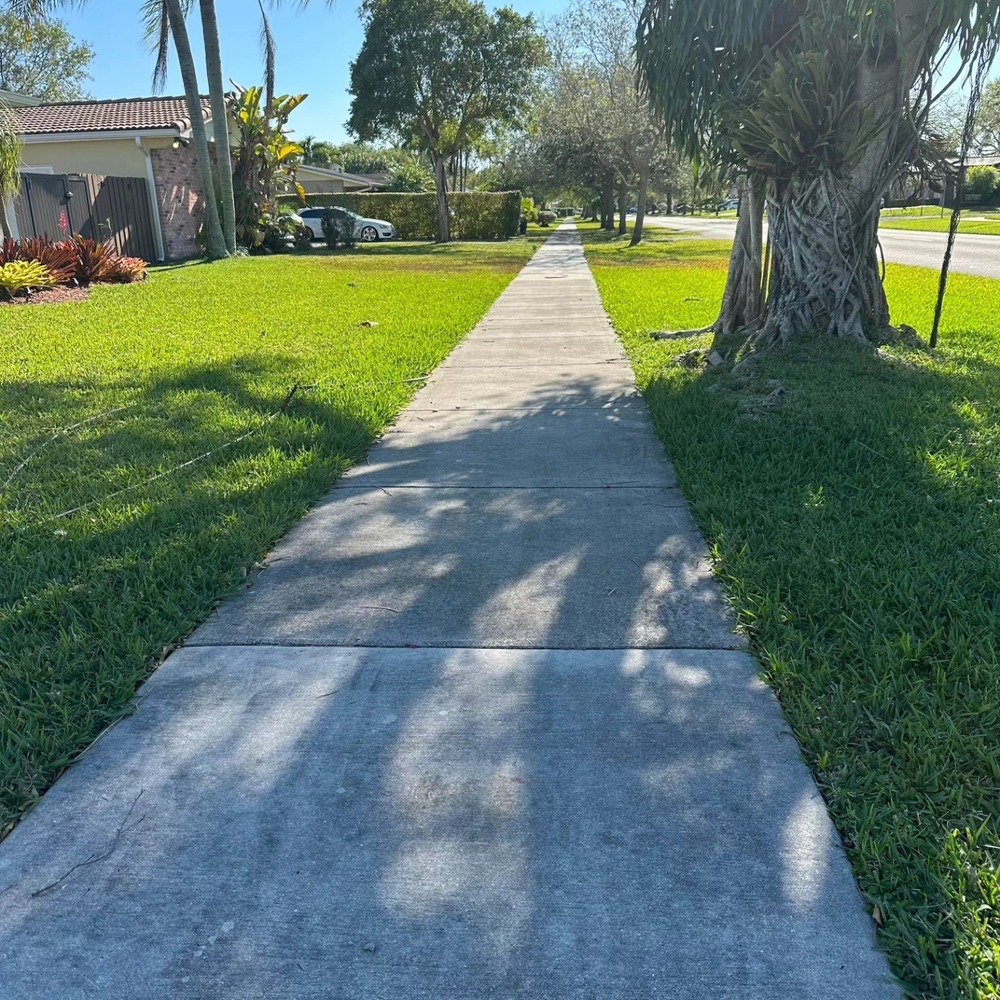
- Driveways and sidewalks: annual for most, more often for high-traffic commercial concrete.
- Waterfront glass and metal: every 6 to 8 weeks on the canals — salt makes this the shortest cycle in the city.
- Gutters: at minimum before hurricane season, plus after heavy leaf drop.
The smartest single window is April through May, right before hurricane season runs June 1 to November 30. A clean roof sheds water the way it's designed to, clear gutters keep overflow off your foundation, and you're ahead of the debris a storm leaves behind. Recurring maintenance plans exist for exactly this reason — they keep the property on a rhythm instead of letting it get to the point where it needs rescuing.
Why Moppey for North Miami
The work here is honest and surface-specific: soft washing where pressure would ruin stucco, shingle, or screen; calibrated pressure on the concrete that can take it; salt-aware attention on the canal streets; and proper hard-water treatment on glass. That's backed by plant-safe soft-wash chemistry, before-and-after photos, a 48-hour re-wash guarantee, and a COI on request for HOAs and commercial managers. We're insured, we speak English and Spanish, and our reputation is 43 real Google reviews from actual Miami property owners. No damage, no streaks, no shortcuts. For a free quote — most answered the same day — call Moppey at +1 877-754-5614.