
Local guide
Exterior cleaning in Morningside: the complete guide
Cleaning a home in a National Register historic district
Morningside is not a generic Miami subdivision, and it should not be washed like one. Platted in 1922 by the Bay Shore Investment Company, it became Miami's first local historic district in 1984 and was listed on the National Register of Historic Places in 1992. The protected core runs roughly from NE 55th to NE 60th Street, between Biscayne Boulevard and the bay, and holds more than 200 single-family homes designed by a genuine roster of early South Florida architects — Kiehnel and Elliott, who brought Mediterranean Revival to the region, and Marion Manley, the state's first licensed female architect, among more than forty names. That pedigree changes the job. On a house that is period-original and sitting inside a designated district, the goal is never to make a surface look new by force. It is to lift decades of biological growth and salt haze off finishes that were never meant to be replaced, using the gentlest method that actually works.
That is worth understanding before anyone points a wand at your house. Exterior cleaning — soft washing, gutter clearing, driveway and glass work — is ordinary maintenance and does not trigger the City of Miami's Certificate of Appropriateness process the way an alteration or a material change would. But the reason the district exists is exactly why careless washing does so much harm here. Blow the granular texture off original stucco, spall a run of 1920s brick, or crack a field of clay barrel tile, and you have not just made a mess — you have degraded a contributing historic structure. We treat these homes as what they are.
The Morningside surface mix, block by block
Walk the district and you see three architectural layers, and each one wants a different touch:
- Mediterranean Revival and Mission-style homes — the signature of north Morningside. Textured stucco, arched openings, wrought-iron balconies and grilles, and clay barrel-tile roofs. Soft, porous, and unforgiving of pressure.
- Art Deco and Streamline Moderne houses — smoother stucco, flat and low-slope roofs, glass block, and metal casement windows that salt loves to attack.
- Vernacular frame cottages — older wood construction where the enemy is not just algae but trapped moisture, so cleaning has to leave the surface drier, not soaked.
Layered over all of it is Morningside's famous tree canopy — mature oaks, ficus, and royal palms — and its single gated entrance off Biscayne, which keeps the streets quiet and the shade deep. That shade is the whole story on the ground plane: north-facing walls, brick drives, and pool decks under the canopy stay damp for hours after every rain, and damp plus Miami warmth is precisely what mold, mildew, and that slick green algae film feed on.
Keystone, coquina, and the accents Miami builders loved
A detail specific to homes of this era: the decorative stonework. Many Morningside houses use oolitic limestone — Miami's native "keystone" — and coquina for entry surrounds, cladding, and garden walls, along with cast-stone accents. These are genuinely soft, porous coastal stones. High pressure carves them, opens the pores to hold more water and grow more algae, and can permanently darken the surface. On keystone and coquina we clean at low pressure with the appropriate solution and let dwell time, not force, do the work. The same restraint applies to any exposed terrazzo entry or porch — beautiful, period-correct, and easily dulled by an aggressive nozzle.
Salt, iron, and hard water — the trio that ages a bayfront elevation
Morningside's deep waterfront lots put many homes in a real coastal exposure zone, effectively ISO C5-M for corrosion. That means three things attack together on the elevations facing Biscayne Bay:
- Salt film builds on glass and, left long enough, etches it. On coastal glass it is not only about clarity — it is about protecting the pane.
- Galvanic and general corrosion on metal: wrought-iron rails and grilles, casement window frames, gate hardware, dock cleats, boat lifts, and seawall fixtures all rust faster here. Cleaning them properly — flushing salt, not just wiping — slows that down.
- Hard-water spotting. Miami draws from the Biscayne Aquifer and has some of the hardest water of any major Florida city, around 11 grains per gallon. That matters when you irrigate near the house: sprinkler overspray dries into mineral spots on glass and stone that a squeegee will not touch. We account for it, and we can advise on adjusting sprinkler heads that are quietly etching a bayfront window every night.
Seawalls and docks are their own line of work on estate lots — algae, barnacle scum, and salt crust on concrete caps and pilings — and we handle them with the same surface-first judgment.
Efflorescence: the white haze that must be read correctly
That chalky white bloom on stucco, brick, a paver drive, or a pool deck is efflorescence — mineral salts migrating to the surface as water moves through masonry. It is common on older Morningside walls and on any deck sitting over damp coastal ground. The mistake is sealing over it or scrubbing it wet, which drives it back in to return worse. It has to be treated correctly and the surface allowed to release its moisture before any resealing. Reading efflorescence right — versus mold, versus a permanent stain — is half of doing this job well on a historic home.
A realistic Morningside maintenance rhythm
Because these surfaces are delicate and the climate is relentless, the smart move here is a plan rather than a panic wash after a stain sets in. A cadence that fits most Morningside homes:
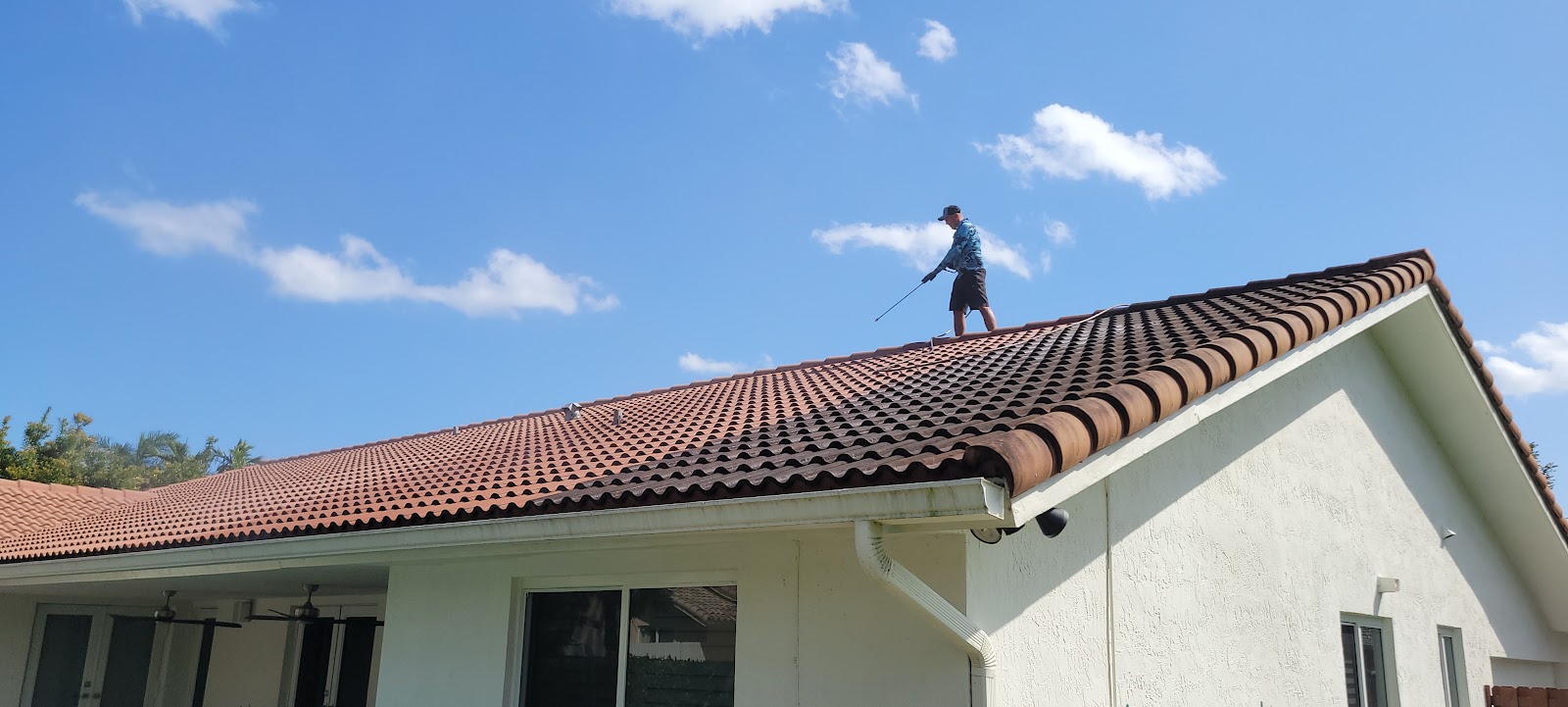
- Late winter / early spring: roof soft wash and full gutter clear-out — done before hurricane season (June 1–November 30) so the roof sheds clean and the gutters, which pack with palm fronds under this canopy, actually drain away from the foundation.
- Recurring through the year: the shaded, humid elevations and ground surfaces that green up first — a maintenance interval keeps them from ever reaching the ugly stage, and treating growth at the root means it comes back slower each time.
- After storm season: a reset wash to clear salt spray, debris film, and anything the summer grew.
Recurring maintenance plans are built for exactly this, and everything we do is backed by a 48-hour re-wash guarantee — if a spot comes back within that window, we come back. We carry insurance and can provide a certificate of insurance on request, which matters on estate-scale properties and for any HOA or association documentation.
More than the main house
Morningside is primarily residential, but the district edges Biscayne Boulevard, and we work both sides of that line — single-family and estate-scale homes inside, and storefronts, offices, and mixed-use facades along the boulevard where salt, road grime, and mildew dull glass and stucco. Whether it is a Mediterranean Revival roof, a brick carriage drive, a bayfront wall of glass, or a Biscayne storefront, the approach does not change: the right method for the surface, no damage, no streaks, no shortcuts.
If you own in Morningside and want a straight read on your specific home — which surfaces need soft washing, which can take calibrated pressure, and a realistic schedule for a house on the water — Moppey will walk the property and put together a free quote. Call +1 877-754-5614; most quotes are answered the same day, and hablamos español.