Local guide
Exterior cleaning in South Beach: the complete guide
The South Beach exterior-cleaning playbook, block by block
South Beach isn't one cleaning job — it's five or six different ones packed into a single square mile. The pastel Deco strip on Ocean Drive cleans nothing like the glass-and-steel towers on West Avenue, and neither of those is anything like a coral-rock cottage in the Flamingo/Lummus historic district or a waterfront villa on Star Island. If you own, manage, or run a business here, the single most useful thing to understand is that the surface dictates the method, and South Beach hands you an unusually wide range of surfaces on an unusually harsh barrier island. This guide goes past the basics and into how the work actually gets done down here — the timing, the micro-geography, and the details that separate a clean that lasts from one that streaks back in a month.
Know your micro-neighborhood — the salt load isn't the same everywhere
"South Beach" covers ground that ages very differently under the same sun. South of Fifth (SoFi) is the luxury pocket — Continuum, Murano, Apogee, Portofino — glass towers and townhomes sitting between the ocean and Government Cut, which means they catch salt from two directions plus the fine grit thrown up by cruise-ship and port traffic. Flamingo/Lummus, the residential core between the beach and West Avenue, is dense with 1930s–40s low-rise apartment buildings, painted stucco, terrazzo entries, and jalousie windows that trap salt film in every slat. West Avenue and Sunset Harbour face Biscayne Bay, not the Atlantic, so the exposure is more humidity-and-mildew than raw salt-spray — shaded courtyards and marina-adjacent buildings green up on their north elevations long before the ocean side does. And the man-made islands — Star, Palm, Hibiscus, the Venetian chain — are single-family waterfront estates where seawalls, docks, travertine decks, and expanses of glass all take a marine load with zero buffer.
The practical upshot: a cleaning cadence that's right for a bayfront building on West Ave is too infrequent for an oceanfront tower in SoFi, and the reverse wastes money. We set the schedule to where the building actually sits, not to a generic Miami calendar.
Terrazzo, keystone, and coral rock — the surfaces most crews get wrong
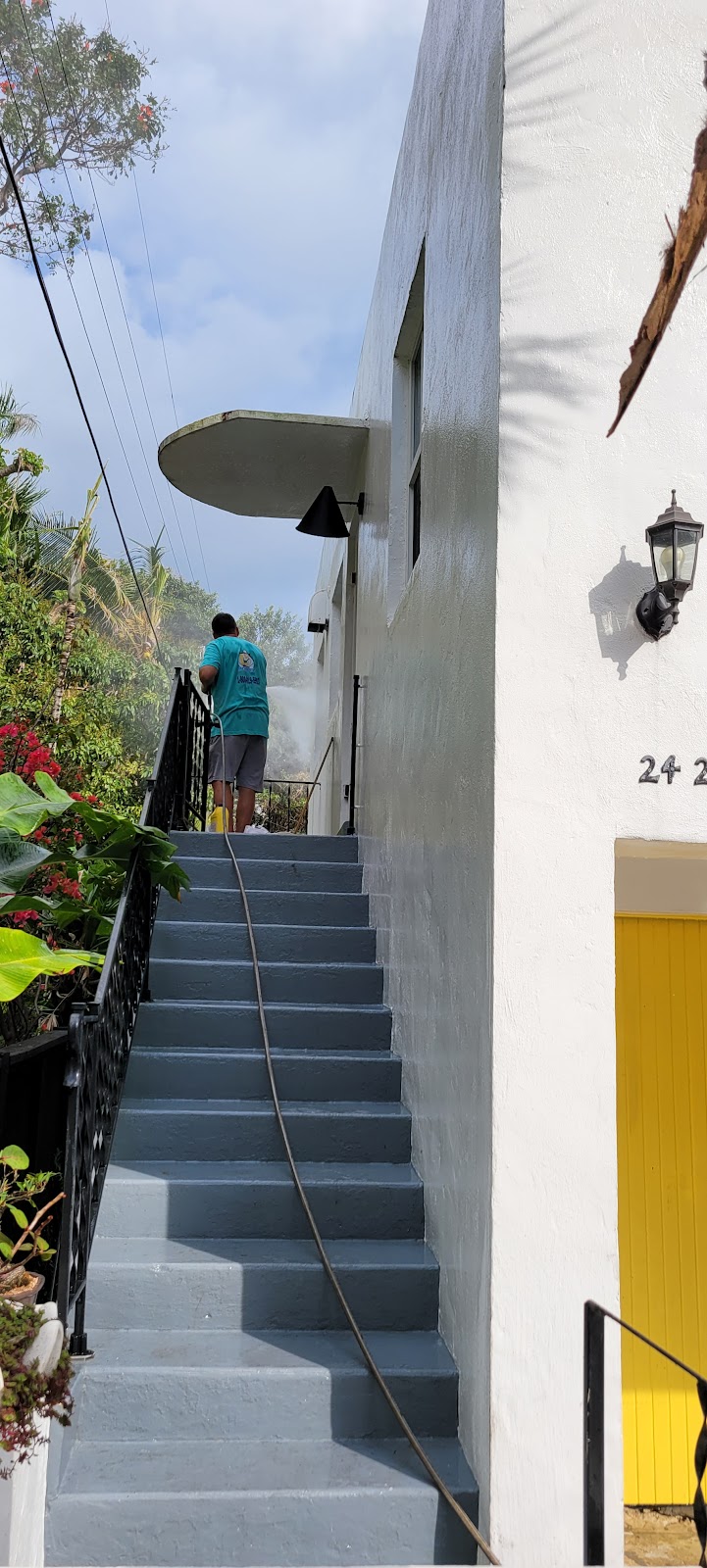
The base page already covers why you soft-wash painted Deco stucco instead of blasting it. What gets less attention is the floor and step material that defines pre-war South Beach: terrazzo and Miami keystone (oolitic coral rock). Terrazzo entries, lobby thresholds, and stair treads are everywhere in the Flamingo district, and they're porous. Sunscreen, salt, and foot traffic drive gray staining down into the surface where a surface rinse never reaches, and algae takes hold in the shaded terrazzo of a north-facing entry. It cleans beautifully — but with the right alkaline pre-treatment and dwell time, not a high-pressure wand that opens the pores and pits the finish.
Keystone and coral rock — the honey-colored fossil stone in older facades, garden walls, and planters — is soft and full of natural voids that hold moisture and grow black mildew. It responds to low-pressure soft washing and patience, never to a pressure setting meant for a concrete driveway. Getting this wrong is expensive on a barrier island where the salt has already been working on the same stone for decades.
The hurricane-season calendar is different on the beach
Everyone in Miami thinks about hurricane season (June 1 to November 30), but on a barrier island the pre-storm exterior window matters more than almost anywhere in the county. The best time to get exterior work done is April and May, before the season opens and before the daily afternoon storms of high summer make scheduling unpredictable. Two South Beach-specific reasons:
- Flat and low-slope Deco roofs shed water toward internal drains and scuppers, not off an eave. When those drains clog with debris, wind-driven rain backs up on the roof instead of draining — exactly the wrong thing before a storm. Clearing them ahead of season is cheap insurance.
- Gutters and scuppers fill with palm fronds and sea grape leaves. A clogged run overflows toward the foundation and stains the facade you just paid to clean. Pre-season is when to clear them.
There's also an after window worth naming: the first clear stretch post-storm, when salt spray and blown organic debris have coated everything on the island at once. A single reset wash after a big blow keeps salt from sitting on glass and metal long enough to etch and corrode.
Hospitality, short-term rentals, and storefronts — clean is a revenue line
South Beach runs on how it looks. A boutique hotel on Collins, an Ocean Drive cafe, a Lincoln Road storefront, or a high-turnover short-term rental all live and die on curb appeal, and grime here is fast — salt film, sunscreen haze, and pedestrian fingerprints put a fresh clean on the clock in days, not months. For hospitality and retail clients the answer is almost always a recurring maintenance plan scheduled around business hours: early-morning or pre-opening washes of storefront glass, entries, awnings, and sidewalk frontage so the property reads sharp when the first guests arrive. For rental owners, a between-guest exterior touch on balconies, glass, and pool-deck surfaces protects the photos the listing depends on. Recurring plans also cost less per visit than one-off deep cleans, because grime never gets a chance to bond.
Salt, metal, and glass — the corrosion clock
South Beach sits in an ISO C5-M "very high" marine corrosion zone. That classification isn't marketing — it means unprotected metal here corrodes at the top of the international scale. Aluminum balcony railings chalk and pit, stainless hardware develops tea-staining, and steel fixtures rust if salt is allowed to sit. Regular exterior washing isn't cosmetic maintenance on this island; it's how you slow the corrosion clock on railings, window frames, garage doors, light fixtures, and glass balustrades. On the glass itself, salt that dries and isn't removed etches the surface permanently — which is why oceanfront glass here is a maintenance item, not an occasional chore. Pair that with the fact that Miami has the hardest tap water among major Florida cities (roughly 11 grains per gallon from the limestone Biscayne Aquifer), and any glass rinsed with untreated water spots — so the pros use a proper acid treatment for existing calcium buildup and the right water for the final rinse.
What the right method actually looks like, surface by surface
- Painted Deco/MiMo stucco and accent walls: soft wash under 500 PSI with a plant-safe hypochlorite solution — chemistry does the work, not force.
- Terrazzo and keystone: low-pressure with pre-treatment and dwell time; no wand blasting.
- Concrete sidewalks, motor courts, and driveways: calibrated pressure, where it genuinely belongs.
- Travertine and paver pool decks: controlled pressure; if you see white efflorescence haze, it gets treated before any sealing, never sealed over.
- Glass and metal: coastal-grade attention, hard-water treatment where needed, and a cadence that matches the salt load.
Access, insurance, and the historic district
Most South Beach buildings past ladder height — and nearly all condo and HOA boards — require proof of liability and workers-comp coverage before any crew goes up, plus a certificate of insurance (COI) on file. That's standard here and something to have squared away before you book. Much of South Beach also sits inside the Miami Beach Architectural (Art Deco) Historic District, where gentle, surface-safe methods aren't just best practice — they're what the protected facades require. The right approach protects the building and keeps you on the right side of how these landmarks are meant to be maintained.
South Beach punishes shortcuts. The salt, the soft historic surfaces, the hard water, and the foot traffic all conspire to make a bad clean look worse than no clean at all. Done right — the correct method matched to each surface, on a cadence that fits where your building sits — the exterior stays sharp and the salt stays off the metal. Moppey works this island every week, is backed by 43 real Google reviews, and speaks English and Spanish. For a free, no-pressure quote on your South Beach property, call +1 877-754-5614 — most requests are answered the same day.