
Local guide
Exterior cleaning in Brownsville: the complete guide
Cleaning the Brownsville that's actually here
Brownsville is one of the oldest continuously lived-in neighborhoods in Miami, and its buildings tell that story on every surface. This is a two-square-mile grid that first showed up on a Dade County plat map in 1916, filled in as single-family housing through the 1940s and 50s, and became one of the only places in the county where a Black family could buy a solid, reasonably priced home on a working wage. What that history leaves behind, from a cleaning standpoint, is a neighborhood built almost entirely out of concrete — CBS bungalows, masonry duplexes, prefabricated public-housing blocks, community landmarks, and now high-rise towers by the Metrorail. Concrete and stucco hold Miami's climate longer than almost any material out there, and Brownsville has more of it, and older, than most Miami neighborhoods. That's the job. Below is what a homeowner, a landlord, or a property manager here actually needs to know before booking exterior work — the stuff that doesn't fit in a quick intro.
The four building types on a Brownsville block
Most Miami location guides talk about "homes" as if a neighborhood is one thing. Brownsville isn't. Walk the grid between NW 27th and NW 32nd Avenues and you'll pass four distinct surfaces that each want a different approach:
- Mid-century CBS single-family homes. One-story concrete-block-and-stucco houses from the 40s and 50s, barrel-tile or aging shingle roofs, short driveways, carports, and jalousie windows. Many have been in one family for two or three generations. The paint and stucco is old, so pressure is the enemy — these get soft washed.
- Masonry duplexes and small multi-family rentals. Brownsville has a lot of two- and four-unit rental stock. For a landlord, the exterior is what a prospective tenant sees first and what keeps mold complaints and slip hazards off the books. Curb appeal here is a leasing tool.
- Prefabricated public and affordable housing. The neighborhood's larger complexes — the kind built with pre-cast concrete wall panels, balcony railings, and stair units — are a specific surface. Long, repetitive concrete elevations, shared breezeways, exterior stairwells, and common walkways that see constant foot traffic and grow biofilm fast. These are managed jobs, not one-house visits.
- The Brownsville Transit Village towers. The five residential towers that went up on the old Metrorail parking lot brought high-rise living to the neighborhood. Those come with balconies, upper-floor glass, and shared podium decks — surfaces that need proper access equipment and a contractor carrying the right liability and workers-comp coverage before anyone gets on site.
We match the method and the equipment to whichever of these you own or manage. That's the whole point.
Why old block behaves differently than new construction
Brownsville sits inland — no direct salt spray off Biscayne Bay — but the surfaces here are decades older than what you'll find in a newer subdivision, and age changes the chemistry. Fifty- and sixty-year-old stucco is more porous. It has picked up hairline crazing, patched repairs, and layers of paint of different ages. Miami's humidity and near-daily summer rain keep the shaded north and east walls damp long enough to grow the same black-green mildew film you'd find anywhere, but on old porous block that growth sinks in deeper and comes back faster if it's only rinsed instead of treated. That's why a plant-safe soft-wash solution under 500 PSI matters more here, not less — it kills the organism at the root instead of blasting the surface off the face of an old wall.
Miami also has the hardest tap water of any major city in Florida — roughly 11 grains per gallon out of the Biscayne Aquifer. On old concrete and block, that hard water shows up two ways. First, as mineral spotting and scale if a surface is just hosed and left to dry in the sun. Second, and more specific to older masonry, as efflorescence — the chalky white haze that migrates out of the block itself when moisture moves through it. On a lot of aging Brownsville walls, retaining edges, and planters, that white bloom gets mistaken for something that can be scrubbed off. It can't be power-washed away; it has to be treated with the right approach, and if a wall is going to be painted or sealed, the efflorescence has to be dealt with first or it pushes right back through the new coating. Knowing the difference between mildew, hard-water scale, and efflorescence on an old surface is the whole difference between a wall that stays clean and one that greens back up in a month.
Roofs on older homes: warranty and the granule problem
The long dark stains on Brownsville's barrel-tile and shingle roofs are Gloeocapsa magma, a cyanobacteria that feeds on the limestone filler in asphalt shingles and thrives in the humidity. The reason to care about method here isn't cosmetic. On an older asphalt roof, the protective mineral granules are already thinning with age — that's what keeps UV off the asphalt and keeps the shingle alive. High-pressure washing knocks those granules loose, shortens whatever service life the roof has left, and voids most manufacturer warranties outright. So a roof gets soft washed at low pressure every time: the solution lifts the stain and kills the organism, the roof keeps its granules and its warranty. On a home that's been in the family for decades, protecting the roof you have is a lot cheaper than replacing it early.
Timing it around hurricane season
Brownsville's exterior work has a natural calendar, and it's worth planning around. Hurricane season runs June 1 through November 30, and the smart pre-storm window is April and May — that's when to get gutters cleared and roofs cleaned before the rains hit. On these older homes with lower roofs and mature trees, gutters and roof valleys pack with palm fronds and windblown debris. A clean roof and clear gutters shed water away from the foundation; clogged ones overflow toward it, right when the summer storms are dumping the most water on the slab. Getting the roof, gutters, and walkways done in spring is preventive maintenance, not just cleanup, and it puts you ahead of the rush when everyone books at once after the first storm scare.
For landlords and property managers: recurring beats reactive
A one-time wash on a rental or a managed complex looks great for about six months, then Miami's humidity brings the growth back on the shaded elevations and the shared walkways. On multi-family and public-housing-style stock, that recurring biofilm on breezeways, exterior stairs, and common walkways isn't just a look — it's a slip-and-fall liability the day it rains. A maintenance schedule keeps those surfaces from ever reaching the point where they're hazardous or genuinely dirty, spreads the cost out, and means you're never scrambling before a unit turn or an inspection. We build recurring plans around exactly that, and for commercial and managed properties we carry the liability and workers-comp coverage a manager needs to let a crew on site, with a certificate of insurance available on request.
The civic side of the neighborhood
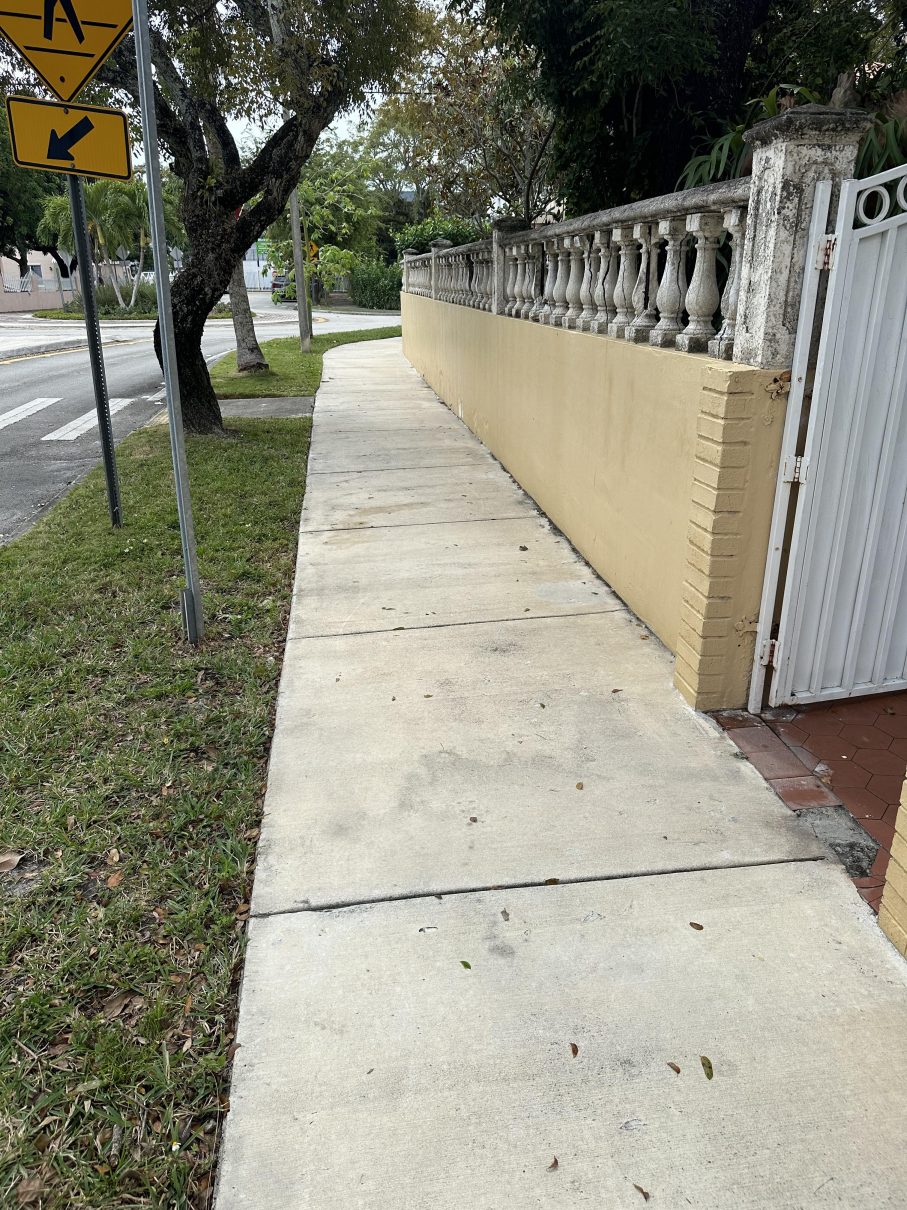
Brownsville is dense with landmarks that matter to the people who live here — the historic Hampton House on NW 27th Avenue, the Lincoln Memorial and Evergreen cemeteries, longtime churches, and community buildings that are among the oldest and best-cared-for structures on the grid. These get treated the way they deserve: exterior walls house washed and soft washed, aging tile or flat roofs cleaned at low pressure, and sidewalks, steps, and parking aprons brought back to clean without gouging concrete that's been down for generations. For any of it — a home, a duplex, a storefront on the NW 27th Avenue or NW 54th Street corridor, or a managed complex — the standard is the same: no damage, no streaks, no shortcuts, backed by 43 real Google reviews.
If you own or manage property in Brownsville and want the outside handled by a crew that understands old Miami block, call Moppey at +1 877-754-5614 for a free quote. Most are answered the same day, and Hablamos Español.