Moppey Spottless Clean Pros
Exterior cleaning services in Little Haiti, Miami

Serving Little Haiti

Cleaning Services Little Haiti, Miami

Exterior cleaning for Little Haiti — soft washing painted stucco and CBS walls, storefront and sidewalk pressure washing, driveway and walkway cleaning, house washing, and commercial exterior care for homes, botanicas, galleries, and NE 2nd Avenue businesses.

Exterior cleaning throughout Little Haiti & nearby areas

Rated 5★ · 43 reviewsFully InsuredResidential & CommercialSoft Wash SafeHablamos Español

Local exterior cleaning

Exterior cleaning in Little Haiti

Little Haiti is one of Miami's oldest neighborhoods, and its walls tell you so. This is the old Lemon City, so the housing stock runs to 1920s-through-1940s bungalows, wood-frame cottages, and single-story concrete-block homes on tight lots off NE 2nd Avenue and the 50s and 60s streets. Most of it is painted stucco and CBS block, a lot of it in the bright Caribbean colors the neighborhood is known for. That paint and those older surfaces are exactly what makes exterior cleaning here a job for the right method, not the most pressure.\n\nThe commercial side is its own thing. NE 2nd Avenue is a working corridor — botanicas, record shops, restaurants, the arched Caribbean Marketplace and the Cultural Complex — and it's mixing now with galleries, studios, and warehouse conversions spilling in from the Design District and Little River. Those storefronts get judged at the sidewalk. Gum, grease tracked from kitchens, spilled drinks, and the gray film that builds on any walkway with foot traffic all sit on the concrete out front, and a dirty entrance costs a business the walk-in before anyone reads the sign.\n\nLittle Haiti sits inland of the bay, so salt air isn't the driver here the way it is on the beach — humidity is. Year-round warmth, near-daily summer rain, and shade off mature trees keep painted walls, driveways, and north-facing surfaces damp long enough to green up with mold and algae. We clean for that: soft washing where high pressure would blast the paint off an old wall, controlled pressure on the concrete that can take it, and honest advice on what actually needs cleaning. No damage, no streaks, no shortcuts.

Why Moppey

Why Little Haiti property owners call Moppey

Little Haiti property owners and businesses call Moppey because we clean for the surface actually in front of us — an old painted CBS bungalow, a bright NE 2nd Avenue storefront, a gallery wall, a stained sidewalk — and each one wants a different method. We soft wash where high pressure would blast paint off a decades-old wall, use calibrated pressure on porous block and original stucco, and bring real pressure only to the concrete driveways and walkways that can take it. We know the Miami climate driving these problems: the humidity and shade that green up walls inland, the hardest tap water of any major Florida city that spots glass, and the hurricane-season timing that makes spring the smart time to clean. We handle both residential homes and the arts-and-commercial side of the neighborhood, we're insured for storefront and multi-unit work, and it's backed by 43 real Google reviews from across Miami. No damage, no streaks, no shortcuts — free quotes, most answered same day. Hablamos Español.

Surface-safe methodsMiami climate knowledgeResidential & commercial43 five-star reviews
I had a very last-minute request to clean my roof that I thought needed to be changed, but I was amazed with the work quality the Moppey team provided. It appears our roof only needed a good cleaning — it looks like new! Excellent customer service. I definitely recommend Moppey.
Audrius G.Roof Cleaning Verified Google review
100% recommend! I was only going to have my windows cleaned but they did such a good job I also included my patio and the driveway. They are very precise with every detail.
Jaime L.Windows • Patio • Driveway Verified Google review
Insured — COI on request
Plant-safe soft washing
Before & after photos
Satisfaction guarantee

Local guide

Exterior cleaning in Little Haiti: the complete guide

Cleaning the neighborhood that wears its color on the outside

Little Haiti is a paint neighborhood. More than almost anywhere else in Miami, the exterior is the identity here — the aquamarine, mango-yellow, and coral facades that give the old Lemon City its Caribbean look, the gingerbread fretwork carried over from Haitian French-Creole building tradition, and the murals that turned NE 2nd Avenue into an open-air gallery. That changes the whole logic of exterior cleaning. On a beach high-rise the enemy is salt; here the enemy is the humidity and shade that quietly eat that color, and the cleaning has to protect the finish, not just remove the grime sitting on top of it. Every method decision on a Little Haiti property starts from one question: what is this surface, and how do we clean it without touching the color or the woodwork that makes it worth cleaning?

The gingerbread problem: ornamental wood and decorative trim

The Lemon City-era homes and the gingerbread-styled commercial buildings around the Caribbean Marketplace carry something most Miami neighborhoods don't — heavily worked exterior detailing. Fretwork around eaves and windows, turned porch posts, scalloped bargeboards, and layered trim. That ornamentation is a magnet for organic growth because every carved recess holds moisture and shade, and it is the single worst place to point a pressure wand. High pressure splinters old wood, blows out glazing putty, and drives water into joints that then rot from the inside.

We treat detailed trim and painted wood as a soft-wash-only zone. Low-pressure application of a surface-safe cleaning solution does the work chemically, the growth is rinsed out of the recesses gently, and the carved profile survives intact. The same rule protects the shiplap and clapboard on the wood-frame cottages that still stand in the neighborhood — original wood siding is thirsty, and it needs cleaning that lifts algae without saturating the boards or lifting decades-old paint.

Murals and painted feature walls

Serge Toussaint's murals and the countless commissioned pieces on shopfronts and warehouse flanks are part of what people come to Little Haiti to see — and they are exterior paint sitting in Miami weather, which means they collect dust film, mildew shadowing, and grime at the base like any other wall. Cleaning a mural is not a pressure-washing job. It's a careful, low-pressure, chemistry-light rinse that a lot of pressure-washing outfits simply shouldn't attempt. If you own a building with a commissioned mural, tell us before we quote. We would rather protect the artwork and clean only the surfaces around it than risk fading or lifting something that can't be replaced.

The commercial corridor and the warehouse conversions

Two commercial worlds overlap here. There's the working NE 2nd Avenue frontage — botanicas, record shops, Haitian restaurants, and markets — where the entrance is judged from the sidewalk and a dark, gum-studded walkway loses the walk-in before anyone reads the sign. And there's the newer layer pushing up from the Design District and into Little River: gallery conversions, studios, breweries, and CBS warehouse shells getting a second life. Those big block walls and roll-up doors are a different job again.

  • Restaurant frontages carry grease that tracks out the door and bonds to concrete. Degreasing pre-treatment plus a flat surface cleaner pulls it up evenly; a raw wand just smears it and leaves stripes.
  • Warehouse and gallery block wants calibrated pressure — the older the block, the gentler — and often a soft wash on the upper wall where growth lives and pressure can't safely reach.
  • Roll-up doors and loading bays collect road film, tag residue, and rust bleed at the track. Each cleans differently depending on whether it's raw metal, painted steel, or coated.

For any storefront or multi-unit building we can schedule around business hours and set up a recurring maintenance plan so the entrance stays presentable instead of swinging between grimy and freshly cleaned. A quarterly sidewalk-and-facade cycle costs less per visit than a once-a-year emergency scrub and keeps the frontage always working for the business.

Efflorescence, hard water, and the block itself

Two things surprise Little Haiti owners. The first is the chalky white haze that shows up on CBS block and stucco after cleaning or after a wet stretch — that's efflorescence, mineral salt migrating out of the masonry, not dirt, and blasting it harder only pulls more to the surface. It needs the right treatment, and on any wall you plan to seal or repaint it has to be handled before the sealer goes on or you trap it. The second is water spotting on glass and storefront windows. Miami has the hardest tap water of any major Florida city — roughly 11 grains per gallon off the Biscayne Aquifer — so ordinary hose water dries to mineral spots. We finish glass and clean-water-sensitive surfaces with treated, low-mineral water so the surface dries clear instead of spotted.

Fences, screens, and the shaded backyard

The lots here are tight and heavily canopied, and that shade is why the back of the property greens up first. North-facing walls, wood and chain-link fences, screen porch enclosures, and shaded pavers stay damp long after the rain stops and turn dark and slick. Wood fences get a soft wash that brightens the boards without furring the grain; screen enclosures get a low-pressure clean that clears the mesh without blowing out the spline; shaded walkways and patios get the pressure the concrete can actually take. Because we treat the growth at the root rather than just rinsing the top layer, it takes noticeably longer to come back — which matters most exactly where the shade never lets a surface fully dry.

How often Little Haiti surfaces actually need it

There's no single answer, but the humidity gives useful rules of thumb for this inland, tree-shaded neighborhood:

  • Painted walls and house washing — every 12 to 18 months for most homes; sooner on the deep-shade side of the house or under heavy canopy.
  • Driveways, walkways, and pavers — annually, or twice a year where shade keeps them damp and slick.
  • Roofs — soft wash when the black Gloeocapsa magma streaking shows, then keep an eye on it; never high pressure, which strips shingle granules and voids the warranty.
  • Storefront sidewalks and entrances — quarterly on a maintenance plan for food and high-traffic frontages.
  • Gutters and flat-roof drains — clear them in spring, April to May, before June 1, because palm fronds and tree debris clog them and a blocked gutter overflows toward the foundation on these older homes.

Why owners here call Moppey

Cleaning Little Haiti well means respecting what makes it Little Haiti — the color, the woodwork, the murals, the old block that's been standing since Lemon City. We soft wash where high pressure would strip paint or splinter trim, calibrate pressure to porous decades-old surfaces, and bring real pressure only to the concrete that can take it. We're insured for storefront and multi-unit work with a COI on request, we bring before-and-after photos, and we stand behind the work with a 48-hour re-wash guarantee. It's backed by 43 real Google reviews from across Miami. No damage, no streaks, no shortcuts. For a free quote on a home, a storefront, or a recurring plan for your building, call Moppey at +1 877-754-5614. Hablamos Español.

Serving Miami, FL & surrounding South Florida.

Get Directions

Good to know

Little Haiti exterior cleaning FAQs

Yes — and that's exactly why we soft wash them. The painted stucco and CBS block that give this neighborhood its color are finished to be seen, and high pressure chalks the paint, strips it, and drives water behind it. We soft wash under 500 PSI with a hypochlorite solution that kills the mold and algae the humidity grows, then rinse clean. The color stays; only the growth comes off.

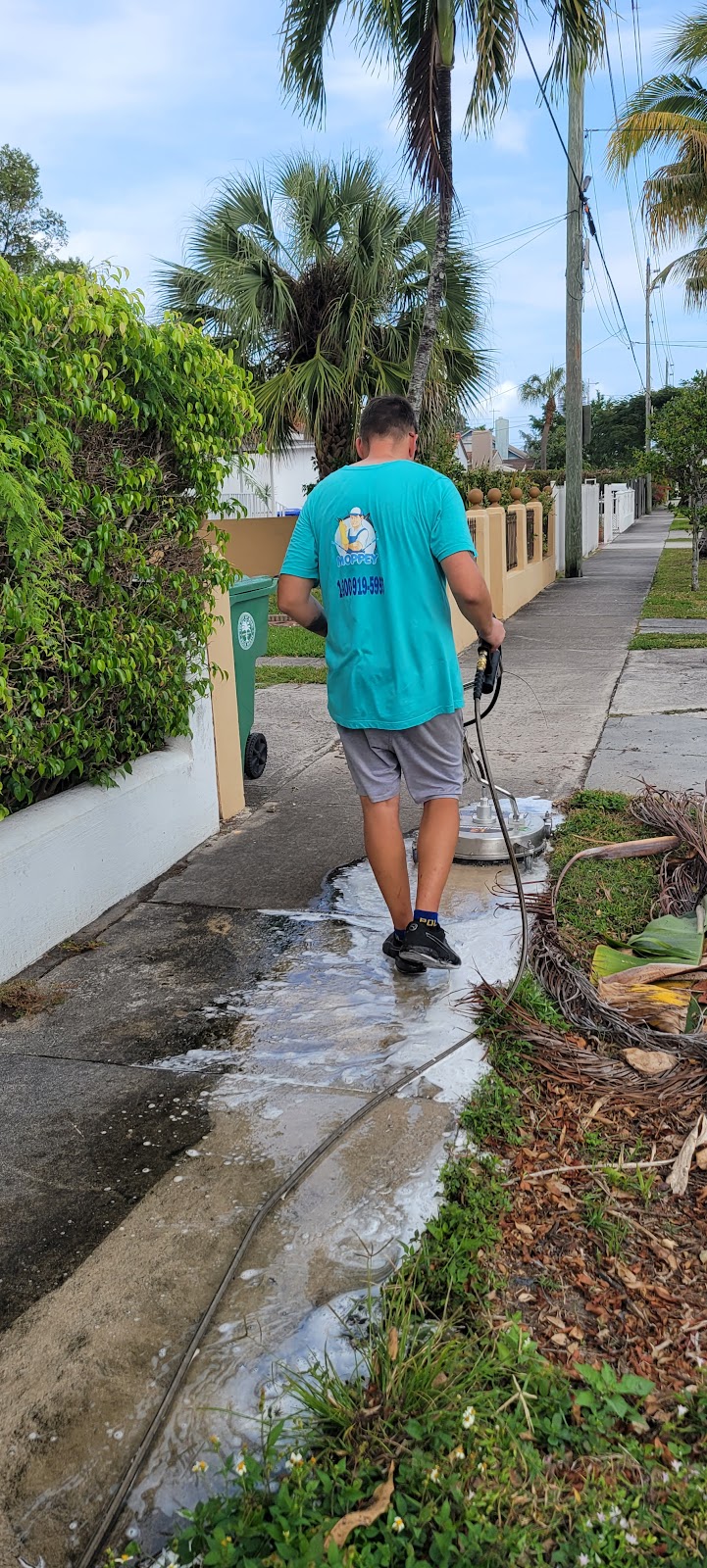
Yes, and it's one of our most-requested jobs in the corridor. For busy frontages we use a flat surface cleaner rather than a raw wand, so gum, grease, and the gray foot-traffic film lift off evenly with no stripes across the concrete. We can schedule early morning to stay out of your customer traffic. Ask for a free commercial quote and tell us your hours.

Only with the right method, which is why we lead with soft washing on surfaces like yours. Decades-old CBS block, coquina, and original stucco are porous and can etch, spall, or lose their finish under an aggressive blast. We calibrate the pressure low and let the cleaning solution do the work, so the wall comes clean without damage you'd have to repair later.

In many cases, yes. We match the approach to the surface underneath — painted stucco, bare block, or a metal roll-up door each clean differently — so the tag comes off without leaving a scoured, patchy halo around it. Send us a photo of the wall and what's on it and we'll tell you honestly what we can do and quote it.

It's humidity and shade, not salt. Little Haiti sits inland of the bay, so the salt air that hits the beach isn't your problem — but year-round warmth, daily summer rain, and shade from mature trees keep your walls and concrete damp long enough for mold and algae to take hold. We clean it back and treat the growth at the root so it takes longer to return, instead of just rinsing the top layer.

April and May are the sweet spot. Hurricane season runs June 1 through November 30, and going in clean matters — a clean roof sheds water properly, and gutters cleared of palm fronds and tree debris drain away from the house instead of overflowing toward the foundation, which is a real risk on these older homes. Getting the roof and gutters done in spring means you're ready before the first storm, not scrambling after one.

Yes, and it's treated as a soft-wash-only surface. The fretwork, turned posts, and scalloped trim that give these homes their character hold moisture in every recess, and high pressure splinters old wood and blows out glazing and joints. We apply a surface-safe cleaning solution at low pressure so the chemistry lifts the algae and mildew out of the detailing, then rinse gently. The carved profile and the paint both survive.

In most cases yes, but it has to be handled carefully and it is not a pressure-washing job. Murals are exterior paint that collects dust film and mildew like any wall, so they need a low-pressure, chemistry-light rinse rather than a wand. Tell us about the mural before we quote so we can protect it and clean the surrounding surfaces properly. If a piece is fragile or irreplaceable, we'll say so and clean only around it.

That's efflorescence — mineral salts migrating out of the CBS block or stucco, not dirt or mold. Blasting it harder actually draws more to the surface, so it needs the right treatment rather than raw pressure. Important: if you plan to seal or repaint the wall, the efflorescence has to be dealt with first, or the sealer traps it and it comes back under the coating. We can assess it and tell you honestly what it needs.

Yes. For restaurants, botanicas, galleries, and any high-traffic frontage on NE 2nd Avenue or in Little River, a recurring plan — often quarterly for sidewalks and entrances — keeps the frontage consistently presentable and costs less per visit than a once-a-year deep clean. We schedule around your business hours, usually early morning, so we're out before your customers arrive. Ask for a free commercial quote and tell us your hours.

That's Miami's hard water. The city has the hardest tap water of any major Florida city, around 11 grains per gallon from the Biscayne Aquifer, so ordinary hose water dries to visible mineral spots on glass. We finish windows and glass storefronts with treated, low-mineral water so the surface dries clear instead of spotted. It's the difference between glass that looks clean and glass that looks streaked an hour later.

Yes, and the shade is exactly why they need it. Heavy canopy keeps the back of these tight lots damp, so wood fences, chain-link, and screen porch enclosures green up and go slick faster than the front of the house. Wood fences get a soft wash that brightens the boards without furring the grain, and screen enclosures get a low-pressure clean that clears the mesh without blowing out the spline. Because we treat the growth at the root, it stays clean longer even in deep shade.

Ready for cleaner surfaces in Little Haiti?

Tell us what needs cleaning and we’ll help you choose the right service — from roof stains and driveway grime to windows, patios, balconies and commercial walkways.

Fast free quotes — most answered same day · Hablamos Español

Call NowGet QuoteDirections