
Local guide
Exterior cleaning in The Roads: the complete guide
Why The Roads is a different kind of cleaning job
Most Miami cleaning companies quote The Roads the same way they'd quote a builder-grade subdivision in Kendall. That's a mistake here. When Mary Brickell platted this neighborhood in 1922 — the diagonal "roads" cutting across the grid, the roundabouts, the median parkways planted with natives — she was building for the long haul, and the housing stock proves it. The median home here dates to around 1950, but the oldest blocks near Brickell Avenue are true 1920s Mediterranean Revival and Mission-style construction. That means original materials most crews have never actually worked on: hand-troweled lime stucco, Dade County pine, coral rock walls, vintage clay barrel tile, and coquina hardscape. Cleaning those surfaces isn't about horsepower. It's about knowing what each one can and can't survive.
The short version: the parts of your property that most need cleaning in The Roads are usually the parts that tolerate pressure the least. That's the whole challenge in one sentence, and it's why method selection matters more here than almost anywhere in the city.
Coral rock, coquina, and Dade County pine — the details nobody else knows to protect
The Roads is one of the few Miami neighborhoods where coral rock walls, coquina piers, and original Dade County pine trim are still standing on ordinary homes rather than in a museum. These are the exact features that make your property worth what it's worth, and they're the exact features a careless pressure crew destroys in an afternoon.
- Coral rock and coquina walls are soft, porous, and full of voids. Turn a pressure wand on them and you drive water deep into the stone, blow out the softer inclusions, and — because this is limestone-based rock over Miami's high water table — you invite efflorescence, the white crystalline haze that pushes salts to the surface as it dries. We hand-treat and low-pressure rinse coral rock, and if it's already showing white bloom we address the efflorescence before any sealing, never after. Sealing over efflorescence just traps the problem.
- Dade County pine trim, soffits, and porch elements are irreplaceable — the old-growth heart pine that made these homes termite-resistant hasn't been commercially available in generations. It gets soft-wash chemistry and gentle rinsing, never a blast that raises the grain or drives water into century-old joinery.
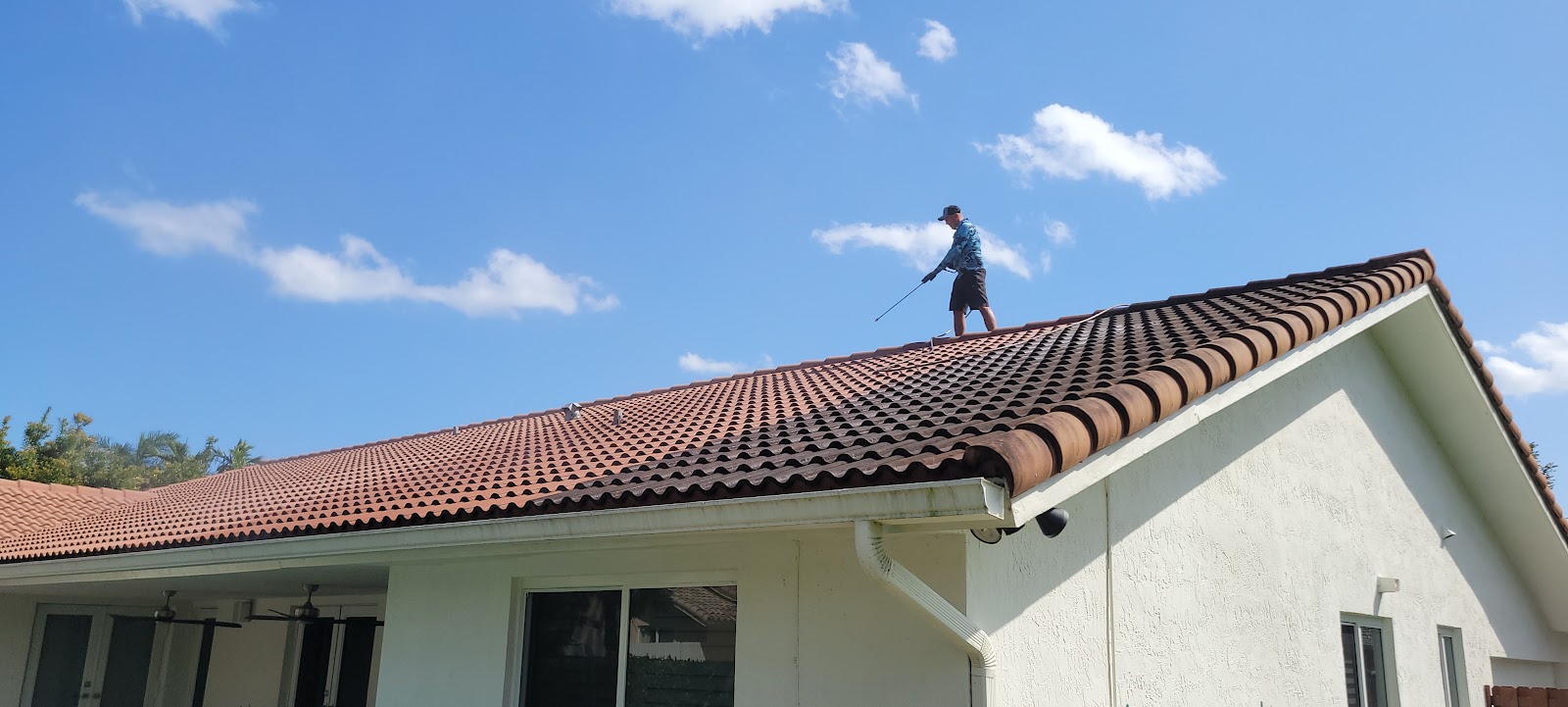
- Vintage clay barrel tile on the oldest roofs is more brittle than the reproduction tile on newer builds. We soft wash it from the ground and from safe footing, never by walking a high-pressure wand across tiles that crack under body weight and a wand's kickback.
If a company can't tell you the difference between coral rock and modern stucco, they shouldn't be touching your house.
The canopy is the whole climate story here
The mature live oak, banyan, and ficus canopy that shades The Roads is the neighborhood's signature — and it quietly drives almost every exterior problem you have. Shade keeps north- and east-facing walls, porch tile, and hardscape damp for hours after rain. Damp plus Miami's year-round warmth is a perfect algae incubator, which is why your barrel-tile roof grows Gloeocapsa magma streaks faster than a sun-baked lot in Doral, and why your walkways go green and slick between rains.
But the canopy does something subtler too: it rains organic debris all year. Oak tannin bleeds brown stains into light stucco and concrete. Ficus and banyan drop a sticky leaf litter that mats in gutter runs and roof valleys. Pollen and seed cases collect in screen enclosures and pool cages. None of that lifts with a garden hose. Tannin staining in particular needs the right chemistry to break the bond with the surface — pressure alone just spreads it around.
Because you're cleaning under a mature canopy and next to the mature landscaping this neighborhood is famous for, plant-safe soft-wash chemistry isn't a nice-to-have. We pre-wet and protect beds, tarp sensitive plantings, and neutralize runoff so a roof cleaning doesn't cost you the crotons, orchids, or heritage trees that took decades to fill in.
The services that actually matter most in The Roads
Not every property needs everything, but here's where the money and the risk concentrate on a typical Roads home:
- Roof soft washing — the single highest-value service here, because barrel tile is both the most-stained surface and the most damage-prone. Done right, it also protects the roof: clean tile sheds water and heat instead of holding a living algae mat.
- House/stucco soft washing — the older lime and cement stucco greens up and holds tannin. Under 500 PSI with proper chemistry, it comes clean without etching, chalking, or forcing water behind the wall.
- Driveway, walkway, and hardscape pressure washing — but graded to the surface. The diagonal walkways and driveways here range from modern slabs (take real pressure) to old coquina, brick, and pavers (need a gentler flat-surface approach and joint-sand awareness).
- Screen enclosure and pool cage cleaning — canopy debris and algae film love screen mesh and frames. These need low pressure so panels and spline don't blow out.
- Gutter clearing — non-negotiable under this canopy, and the pre-hurricane priority (more below).
- Window and glass cleaning — you're minutes from Biscayne Bay and Brickell, so salt film and Miami's hardest-in-Florida water (~11 grains per gallon off the Biscayne Aquifer) still haze and spot the glass here even though you're not oceanfront.
Historic-home realities: sealing, oil stains, and honest limits
Two things separate a pro on a 1920s home from someone who'll leave you worse off.
First, sealing sequence. Owners here often want a freshly cleaned driveway or coral-rock feature sealed to keep it looking good. On limestone-based surfaces over Miami's high water table, sealing before efflorescence is resolved locks moisture and salt into the stone. The correct order is clean, let it fully dry out, treat any efflorescence, then seal. We'll tell you when a surface is ready and when it isn't.
Second, honest limits. A 90-year-old surface sometimes has staining that's cured into the material — decades-old oil in a porous apron, deep tannin in soft coquina, patina that's part of the stone. We'll get it dramatically better, and we'll tell you plainly when "brand new" isn't realistic rather than blasting harder and doing damage chasing a result the surface won't give. On oil and rust, we degrease and treat rather than gouge. That honesty is the point — no damage, no streaks, no shortcuts.
Hurricane season on an older home
Hurricane season runs June 1 to November 30, and the pre-storm window in The Roads is April to May. On a home this old under this much canopy, the timing carries real weight. Gutters here pack with oak litter and palm fronds fast, and an overflowing gutter sends water straight at the foundation and coral-rock footing of a house that predates modern drainage codes. A clean, algae-free roof sheds water and wind-driven rain the way it's supposed to. Getting roof and gutters handled in spring means you're ready before the first named storm, not scrambling after.
How often, and how we prove it
Because shade drives fast regrowth here, a one-and-done cleaning greens up sooner than owners expect. Realistic intervals in The Roads: roofs and stucco roughly every 12–18 months, shaded driveways and walkways every 6–12 months, and coastal-facing glass every 6–8 weeks if you're near the Brickell/bay edge. Many owners here run a recurring maintenance plan so it never gets bad enough to need an aggressive clean — gentler on old surfaces and cheaper over time. We document with before-and-after photos, carry insurance with a COI available on request, and stand behind the work with a 48-hour re-wash guarantee.
We cover all of The Roads and the surrounding blocks — the Brickell edge, Coral Way, Shenandoah, and Little Havana. To get a surface-by-surface plan for your home and a free quote, call Moppey at +1 877-754-5614. Most quotes are answered the same day, and hablamos español.