In-depth guide
Garage Floor Cleaning in Miami: the complete guide
Garage floor cleaning is a different job than "garage cleaning"
Search "garage cleaning Miami" and most of what comes back is organizing and junk removal — crews that box up your clutter, install shelving, and give the floor a quick sweep and mop on the way out. That is a useful service, but it is not what happens to the concrete. A broom and a household mop move the loose dirt around. They do nothing about the oil that has soaked into the pores of the slab, the rubber baked onto the parking path, or the mineral film Miami's water leaves behind. Those are the things that make a garage floor look permanently gray, and they only come out with degreasing chemistry and a proper surface-cleaner pass.
Moppey does the floor itself — the concrete slab, corner to corner — as an exterior cleaning job, not a tidy-up. If you also need the space cleared and organized, that is worth doing, but understand it is a separate trade. What we deliver is the reset on the concrete: the stains treated at the source, the whole slab brought to one even shade, and the runoff managed so you are not left with a wet garage. When those two services are confused, homeowners end up paying for organizing and wondering why the floor still looks dingy. The floor was never the organizer's job.
What is actually staining your Miami garage floor
Concrete is porous, so a garage floor is not so much dirty on top as it is loaded up from within. Knowing which contaminant you are dealing with is what tells us how to treat it, because they do not all respond to the same thing:
- Petroleum oil and grease — engine drips, transmission fluid, gear oil. These sink into the pores and are a chemistry problem first. Water alone, at any pressure, just spreads them. A penetrating degreaser has to break the oil down and float it out before rinsing.
- Hot-tire rubber and scuff — tires heat up while driving, soften slightly, and deposit rubber onto the parking path along with the black marks from turning the wheel. This is a physical film that needs the right cleaner and agitation, not raw PSI that would scour the concrete.
- Rust staining — from a rolling toolbox, a floor jack left in one spot, patio furniture, or rebar too close to the surface. Rust is iron oxide and needs a mild acid or oxalic treatment, never a wire wheel that grinds it deeper.
- Battery acid and brake fluid — these etch and discolor. They are treated and neutralized, not blasted, because the damage is chemical, not just cosmetic.
- Efflorescence — the chalky white bloom that pushes up through the slab as moisture wicks through the concrete and evaporates on the surface. Extremely common on Miami floors and, critically, a sign of vapor moving through the slab.
- Hard-water mineral film — anything wet that sits and evaporates on the floor leaves minerals behind, and Miami's tap water is the hardest of any major Florida city.
A good clean identifies each of these before touching the floor, because the treatment for oil actively works against the treatment for rust, and blasting efflorescence with pressure accomplishes nothing while missing the moisture problem underneath.
The slab-moisture problem competitors never mention
Here is the piece that generic garage-cleaning listings leave out entirely, and it is the single most important thing about a Miami garage floor: the concrete is sitting on ground that is rarely far from water.
Miami sits on the Biscayne Aquifer, the water table is shallow, and the humidity is relentless. That means moisture is constantly moving up through a slab-on-grade garage floor from below — a process called vapor drive. On the surface it shows up as efflorescence and that persistent hazy gray look that comes right back after a quick mop. More importantly, it is the reason garage floor coatings fail in this region. If someone lays epoxy over a slab that is actively pushing moisture up, the vapor pressure eventually lifts the coating off in sheets, no matter how well the epoxy was mixed. This is not a product defect. It is a moisture-management failure that started before the coating went down.
That is why the honest sequence for a Miami floor is: clean and degrease first, deal with any efflorescence, and only then evaluate whether the slab is a good candidate for sealing or coating — ideally with a moisture check. A clean, sound, dry slab is the whole point of the cleaning; what you put on top of it afterward is a decision made from a position of knowing what the slab is doing, not a rushed add-on over a still-damp floor.
How a professional garage-floor clean actually runs
The order of operations matters more than the horsepower. A rushed crew that leads with pressure ends up pushing oil around and leaving wand stripes. Here is what a proper job looks like:
- Walk and assess. Identify each stain type — oil zones, tire path, rust points, efflorescence, any coating already on the floor — and confirm where water can exit (door threshold, apron, or an existing floor drain).
- Clear and protect. The car comes out and the floor gets cleared as much as possible. Items along the walls are worked around, and the threshold and anything stored is kept in mind.
- Spot-treat the stains. Degreaser worked into each oil and grease stain and given real dwell time to break the oil down. Rust and battery-acid points treated separately with the appropriate chemistry.
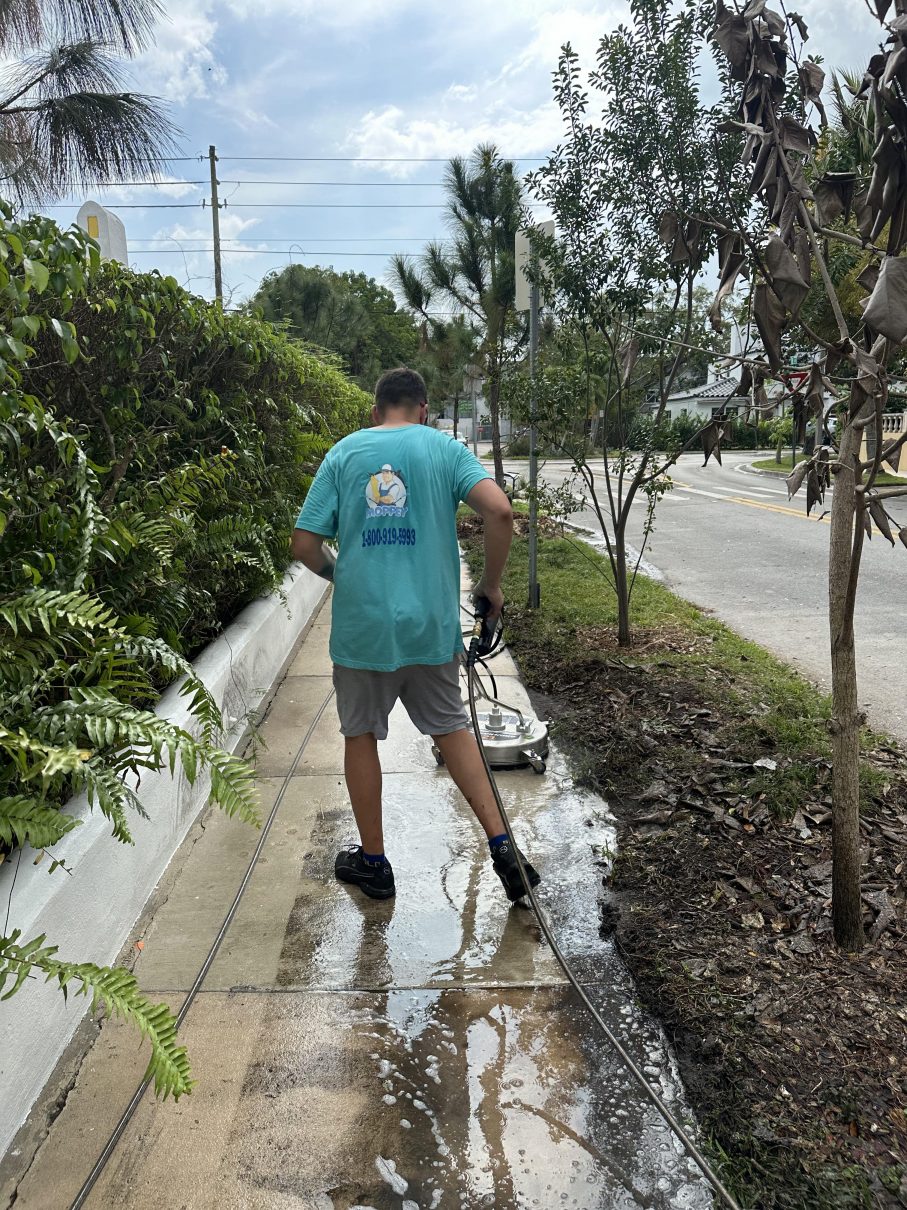
- Surface-clean the whole slab. A flat surface cleaner — a spinning-bar attachment that holds an even distance off the concrete — runs the entire floor so it comes out one consistent shade instead of a patchwork of clean spots and wand lanes.
- Manage the runoff. In an open driveway water runs to the street on its own. Inside a garage it goes nowhere unless it is directed, so the runoff is kept moving toward the door or drain rather than pooling, and low spots are squeegeed out.
- Final rinse and walk-through. A last rinse, a squeegee where needed, and a look at the result together before packing up.
On a bare broom-finish slab that surface-cleaner pass can run at real pressure. On a sealed, painted, or epoxy-coated floor the pressure comes down and the cleaning solution does more of the work, so the grime and tire marks lift without cutting into the finish.
What drives the cost of a garage floor cleaning
There are no flat prices worth quoting sight unseen, because two garages the same size can be very different jobs. The factors that actually move the number:
- Square footage — a single-bay, a two-car, or a three-car floor is the baseline, but it is only the starting point.
- Stain load and age — a floor with one fresh drip is quick; a floor that has been feeding oil into bare concrete for a decade needs more dwell time and passes.
- Surface type — bare concrete, sealed, painted, or epoxy-coated each changes the method and the care required.
- Access and drainage — whether there is a floor drain, how the threshold sits, and how easily runoff can be sent out.
- How much has to move — a floor cleared to the slab cleans faster and more evenly than one we have to work around.
- Add-ons — treating rust or efflorescence, or prepping specifically for a coating, is more involved than a straight wash.
A photo of the floor and any specific stains lets us give a real number fast, which is why the quote is free and most are answered the same day.
How this compares to doing it yourself
A weekend with a rented pressure washer and a jug of degreaser can absolutely improve a garage floor, and for a lightly used slab it may be enough. Where the rental route falls down is on the two things that make a Miami garage floor look bad:
- Even results. Waving a wand by hand leaves stripes and clean patches — the "zebra" look. A flat surface cleaner is what produces one consistent shade, and it is not something most rentals include.
- Set-in stains and runoff. Consumer degreasers and short dwell times barely touch oil that has soaked in for years, and a rental gives you no plan for where the water goes inside an enclosed space, so people flood the garage and push grime into stored items.
A careful professional is not just renting you more horsepower. It is the right chemistry with the right dwell time, the surface-cleaner finish, and — the part that matters most indoors — a runoff plan so you get a reset floor instead of a wet, streaky one. On a coated floor, the case is even stronger: too much pressure from an unfamiliar rental can chew straight through epoxy in seconds.
When to schedule it, and keeping the floor clean
Because a garage is covered, rain never rinses it, so buildup is entirely a function of how often the floor gets cleaned. For most Miami homes once a year keeps it looking sharp. Clean more often if a car leaks, if you track in salt and road film, or if the garage doubles as a workshop. A few habits stretch the result between cleanings:
- Wipe fresh oil and fluid drips as soon as you see them — a fresh spot comes up far easier than a soaked-in one.
- Put a mat or a drip tray under a car you know leaks.
- Keep water from sitting and evaporating on the floor, since that is what leaves mineral film.
- If you are considering a coating, get the slab professionally cleaned and its moisture behavior understood first — that decision is far cheaper to get right before the epoxy than after it peels.
The best window to book, like most Miami exterior work, is spring before hurricane season, when you may already be having the driveway, roof, and gutters handled and can fold the garage floor into the same visit.
Moppey cleans garage floors, driveways, and concrete across Miami and South Florida — residential and commercial, with runoff managed, no wand stripes, and an honest read on what your slab will and will not do. For a free quote, call +1 877-754-5614 or send a photo of your floor through the quote form. Most quotes are answered the same day, and hablamos espanol.