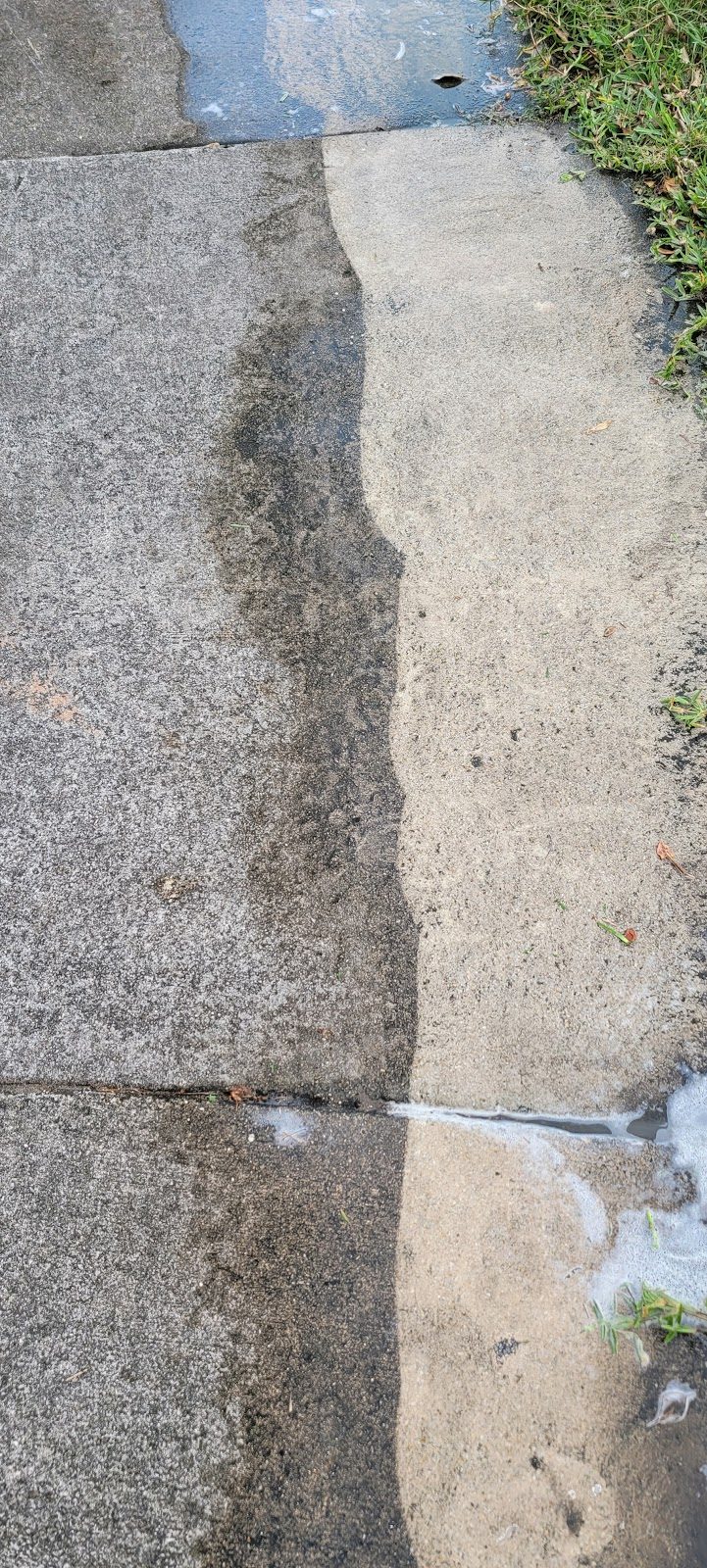
You wash the car, you sweep the leaves, and the concrete still looks dirty. Darker every season. A gray driveway slowly turning charcoal, with black patches spreading from the shady edges toward the middle.
That is not dirt you can sweep away. In South Florida, a black driveway is almost always something living.
Here is what is actually happening under your feet, and why the fix is more about method than muscle.
The black film is organic growth, not grime
Concrete looks solid, but the surface is porous. It is full of tiny pits and channels that hold moisture. In Miami, moisture is never in short supply.
Our climate gives algae, mold, and mildew everything they need to thrive: constant humidity, warm temperatures nearly year round, and frequent rain that keeps the surface damp. Add the shade from a car, a hedge, or the north side of the house, and you have a perfect nursery.
The result is a thin biological layer that darkens the concrete. Most of the black and green you see on a South Florida driveway falls into a few categories:
- Algae — usually green at first, then darkening to gray or black as it matures and dries between rains.
- Mold and mildew — patchy black or dark spots, often worst in shaded, slow-drying areas near landscaping.
- Organic staining — tannins leaching from oak leaves, palm debris, and mulch that sit on wet concrete.
- Embedded dirt and pollution — road film and exhaust that the organic layer traps and holds onto.
Because it is alive, it comes back. That is the part homeowners find frustrating. You can rinse the surface and it looks better for a few weeks, then the black returns because the roots of the growth were never actually killed.
Why Miami concrete gets hit so hard
The same conditions that grow mold on stucco walls and black streaks on roofs are working on your driveway too. It is all one problem: a warm, wet environment that never really dries out.
Humidity and rain grow mold, mildew, and algae on almost every exterior surface here. On stucco we treat it with a soft wash. On a roof, those black streaks are a cyanobacteria called Gloeocapsa magma feeding on the limestone filler in the shingles. Your driveway is simply the horizontal version of the same battle, and it catches every drop of rain plus runoff from the roof and gutters.
Shade makes it worse. Anywhere the sun cannot dry the concrete quickly, the growth digs in. That is why the darkest patches usually sit under trees, along fence lines, and beside the garage.
Then there is Miami's water. We have the hardest tap water among major Florida cities, roughly 11 grains per gallon, drawn from the limestone Biscayne Aquifer. Hard water leaves mineral deposits, and combined with organic growth it builds a stubborn, layered stain that a garden hose will never touch.
Why blasting it with high pressure is the wrong instinct
The natural reaction is to rent the biggest pressure washer you can find and hit the concrete as hard as possible. On a driveway, that instinct causes real damage.
Concrete has a smooth, dense top layer called the cream. Too much pressure strips that surface off, leaving the aggregate exposed and the concrete rougher, more porous, and even faster to stain next time. Once you damage the surface, you cannot put it back.
High pressure also leaves marks. Overlap lines, zebra striping, and gouges show up clearly on a wide flat surface and stay visible for years. And if you only blast the surface without treating the growth, you have removed the top of the algae and left the roots. It regrows within weeks.
The right approach flips the order. You treat first, clean second.
The right way to clean a black South Florida driveway
Getting concrete truly clean and keeping it that way is a two-part process, and it matches how we handle every organic-growth problem in Miami.
First, kill the growth. A cleaning solution does the real work, breaking down the algae, mold, and mildew at the root rather than just knocking the color off the top. This is the same principle behind soft washing a stucco wall or a roof, using the solution to do the heavy lifting instead of the pressure.
Second, clean evenly with controlled pressure. For flat concrete, a surface cleaner attachment spins water at a calibrated pressure across a consistent path. That produces an even, stripe-free finish and lifts the loosened grime without carving into the surface. It is the difference between a driveway that looks uniformly clean and one covered in wand marks.
A few things that make the result last:
- Treat, don't just rinse. If the biological growth is not killed, it returns fast.
- Match the pressure to the surface. Standard poured concrete handles more than pavers or delicate coatings, and each gets a different setting.
- Clean the whole surface, not just the stains. Spot-cleaning leaves obvious lighter patches.
- Mind the runoff. Cleaning solution and lifted grime should be directed away from grass, garden beds, and storm drains.
Pavers and travertine deserve extra caution. Travertine is soft and needs its pressure carefully calibrated, and a white haze on stone or pavers is often efflorescence, mineral salts rising to the surface, which is a different problem that should be addressed before any sealing. Getting that wrong bakes the haze in. That is exactly why the right method for the surface matters more than raw power.
Keeping it clean once it's done
A properly cleaned driveway looks dramatically better, but South Florida will keep trying to grow the black back. You can slow it down.
Keep leaves, palm fronds, and mulch off the concrete so organic debris is not sitting on a damp surface feeding the next bloom. Trim back hedges and branches that keep sections in permanent shade. Redirect sprinklers that soak the driveway every morning. And plan a periodic cleaning, especially heading into hurricane season, when you want the whole exterior, roof and gutters included, in good shape before the summer storms arrive.
Regular maintenance is far easier than letting years of growth build back up. A quick treatment on a lightly soiled driveway beats a full restoration on one that has gone completely black.
Get a straight answer for your driveway
Every driveway is a little different. The type of concrete, the amount of shade, the pavers versus poured slab, and how long the growth has been building all change the approach. No damage, no streaks, no shortcuts, just the right method for the surface.
If your Miami driveway has gone dark and you want it handled properly, we are happy to take a look. Call Moppey Spottless Clean Pros at +1 877-754-5614 for a free quote. Fast, friendly, and most calls are answered the same day. Hablamos Espanol.